blogdowntown
Not currently logged in. [Login or Create an Account]

Stay Connected


History Lesson: Gas Holders
By Eric Richardson
Published: Tuesday, November 21, 2006, at 09:06AM
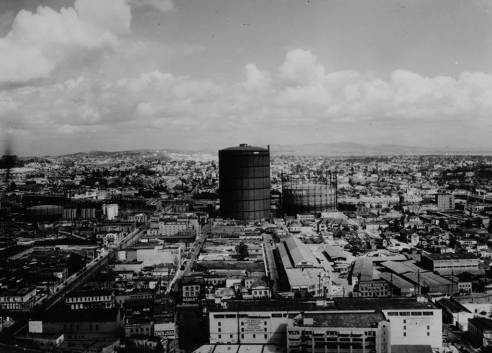
Gas Holder California Historical Society / USC Digital Archives

A gas holder dominates the skyline of the industrial part of Downtown.

If you look at I linked to in the Sunkist post you'll see an enormously large tank or silo back in the distance. I'd seen these same sort of tanks in various other photos and they always seemed impossibly large.

It turns out these tanks were known as "gas holders", and helped supply natural gas to the city. They were in fact laughably large and towered over their surroundings. When one gas holder was built in 1906 its 210 foot height was 35 feet greater than the tallest building in Los Angeles.

Later gas holders climbed higher and wider, reaching up to 300 feet tall (the equivalent of perhaps an 18 or 20 story building) and as large as to hold 10,000,000 cubic feet of gas.

The 300-footer Downtown was at the corner of Ducommon and Center, east of the Civic Center. It was built in 1912 and it's not clear when it was torn down. Shots of Downtown up through 1960 seem to show these structures in the background.

If you go to flickr and you'll get a lot of cool photos from around the world. None of LA that I can find, though.

Update (Wednesday): Brian Humprey of the LAFD writes in the comments:

...and please count our agency among those who harbor no nostalgic feelings about towering containers of flammable gas! :)

In November of 1927 a gas holder in Pittsburgh exploded, killing at least 23 (rubble was still being sifted when the article I'm looking at was written) and injuring 500 more.

The article, which ran in the LA Times, quoted the statement of Harry L. Masser, an engineer with the Los Angeles Gas and Electric Company. Masser wrote that the explosion in Pittsburgh could only have occurred when the tank was empty. He explains:

Everyone has seen what happens when gas direct from an ordinary gas pipe is burned without the use of an air mixer, as in the pilot-light of a heater. A yellow flame is produced, but there is no explosion.

... If a hole were drilled through the side of a full gas holder and a match applied to the outrushing stream of gas, there would be a yellow flame where the gas came in contact with enough air to support combustion, but there would be no explosion, and no harm would result except the waste of gas through the hole.

In the case of the Pittsburgh explosion, it appears that workmen were repairing the holder. To do this it is customary first to empty the holder of gas and fill it with air. Probably a leaky valve permitted a small percentage of gas to enter the holder and form an explosive mixture with the air, after which a workman with a blow torch ignited the fatal charge.

A holder full of ordinary fuel gas has never exploded, and could not explode.

Obviously it's in the gas company's interest to say that. I can't comment on the physics of it.

Update (Thursday): Ed linked in the comments to his post titled . I found this thought especially poignant:

For image makers and photographers in a younger L.A, it must have been an effort to take photographs of Downtown and not have these things just plain get in the way.

Ed's post also features more of Tim Quinn's memories of the tanks and several more photos.

Kevin Roderick also picked up the gas holder bug .

Angelenos older than about 40 probably remember signs for Brew 102 as a downtown L.A. landmark off the Hollywood Freeway. Next to the brewery were some giant tanks that as a kid I naively assumed held vast quantities of beer.

Who knew a post on gas tanks would get this many people's interest?

SHARE:

||

Related Topics


Topic:
History Lesson

13 stories


Conversation

Guest 1

Rico A on November 21, 2006, at 10:39AM – #1

Crazy! I was wondering what that giant thing was in the background from your last post. I just assumed it was a billboard on a building. Leave it to blogdowntown to find out what a gas holder is =)


Guest 2

dennis smith on November 21, 2006, at 11:19AM – #2

What I remember best from driving by the giant tanks when I was a kid was that the tanks actually contracted and collapsed as the supply of gas diminished. It would then be refilled and the tanks would expand to the volume it then held. I remember them being adjacent to the "Brew 102" brewery that was just south of the freeway.


Eric Richardson () on November 21, 2006, at 11:38AM – #3

Dennis: You're exactly right. Basically these things were crazy contraptions with different layers that used the weight of water sitting above the gas to pressurize the gas and send it through the City. I still don't quite understand how the whole thing worked mechanically.


Guest 3

Tim Quinn on November 21, 2006, at 12:01PM – #4

Among my most vivid memories of Downtown in my childhood. Thanks for the pic and the reminder.

(By the way, you have to be about 50 to remember them.)


Guest 4

Brian Humphrey on November 22, 2006, at 12:18PM – #5

...and please count our agency among those who harbor no nostalgic feelings about towering containers of flammable gas! :)

Respectfully Yours in Safety and Service,

Brian Humphrey Firefighter/Specialist Public Service Officer Los Angeles Fire Department


Guest 5

NOLAPDHQ on November 22, 2006, at 01:40PM – #6

My question is.......... what's there now?


Eric Richardson () on November 22, 2006, at 02:27PM – #7

All of those old locations got recycled into various industrial uses. I'm not sure specifically.


Guest 3

Tim Quinn on November 22, 2006, at 03:12PM – #8

One lot is a Viertel's tow yard. the other is the new Urgent Gear facility (there were two big tanks there, maybe three at one time) a part of the gas distribution facility is still there, a brick wall enclosed yard that held compressors and pumps for distribution. at the corner of Ducommun and Center. It is for sale.


Guest 6

Guest 7

John McNary on November 22, 2006, at 08:31PM – #10

There was a big tank like this off the 405 freeway in Long Beach until about 15 years ago.

So Cal Gas now stores its supplies underground, in Playa del Rey.


Guest 8

Curt Gibbs on November 23, 2006, at 08:12AM – #11

Congrats on being top of LAobserved.com on Thanksgiving Day.


Guest 9

Jose on November 23, 2006, at 09:44AM – #12

One thing about gas holders - they were made obsolete by the high pressure pipelines that deliver natural gas today.

They were such a dominant feature from the early years of the last century because the gas used was locally manufactured (from coal and other hydrocarbons) and had to be stored. It was not staightforward to control how much was burned versus manufactured.

As the so called City Gas was replaced by natural gas pipelines after WWII, the need for the gas holders declined as they were used less and less to store pipelined gas. City gas was also notoriously wetter than natural gas due to the water used in the gas holders, so there would normally be a small drop pipe on gas lines to things like water heaters in the old installations to trap debris that got in the lines from the water.

The last gas holder in the LA area was probably the one off the 405 in either Signal Hill or Long Beach, near the Long Beach airport, which finally came down in the late 90's. I don't recall seeing it inflated for a decade or so before it came down.


Guest 3

Tim Quinn on November 23, 2006, at 01:16PM – #13

I wonder, only half jokingly, if the Bonaventure was inspired by the gasometers (the contemporary name for the things). It has some resemblance to them.


Guest 10

George Garrigues on February 02, 2007, at 09:24AM – #14

A correspondent named e, who wrote last October, is half right about the water. The natural gas, of course, floated above the water, and as the gas was depleted the upper structure of the tank actually descended toward the ground. There is an excellent diagram of one of these "gasometers," as they are called, at http://en.wikipedia.org/wiki/Gasometer .

Apparently they are still being used in England.


Guest 11

tate on April 23, 2007, at 08:01PM – #15

Well, not anymore in England. They are planning on demolishing them. That's because they are very old and very expensive to maintain.


Guest 12

hardly on November 17, 2007, at 09:45AM – #16

We do still have a few in use in England. Some of the most elegant were the 'lattice' cast-iron framed ones just north of St Pancras in London, now gone I believe, but there is still a newer welded-steel one operational just east of Oxford, a couple of hundred yards from the Cowley plant where BMW Minis are assembled. Check out Google Earth 51 deg 43' 36" N 1 deg 11' 30" W. I'll post a pic as soon as I can if anyone's interested.


Guest 13

Jovany Crespo on December 21, 2007, at 11:49AM – #17

I remember that brew 102 building because my family drove and pass by the building across from the Union Station in Los Angeles and my family sees it everytime now in 2008 it's gone and it changed there making a extened light rail and parking lot so I will remember that building!!!

Jovany Crespo Dallas Texas


Guest 13

John Crandell on December 21, 2007, at 10:07PM – #18

Jovany,

that site ought to be considered a treasure. It is where the extraordinarilly large Coucil Tree of the Tongva Nation stood for four centuries and a few steps to the west was the location of the city's long lost second pueblo settlement. A quarter mile to the east, the city parks and recreation department has lately considered condemning an auto wrecking yard to create park space. The 102 site, next to the 101, could better be used for park space. Quimby funds should be used at this historic locale. Unfortunately, the mayor as well as the councilman whose district this spot is in have so far been unresponsive to the historical potential of the location, directly across the freeway from Union Station.

Guest 13

Juanito Crandello on December 24, 2007, at 10:53PM – #19

To explain further regards Aliso Street, Jovany, I remember an early exhibit of various artists at the 'Temporary Contemporary', where at the back corner, Chris Burden's installation (of sorts) had encompassed removing a section of the museum's concrete floor and there he dug a pit down into the alluvium of the old riverplain. Perhaps four or five feet in depth. That is all that it encompassed. Viewers were left to contemplate over the cleanly wrought sides of the excavation, the thin layers of strata. One felt emanations in the corner of that building, all of the thousands of years of human history of that one locale. We were forced to confront place and memory. Aliso Road, the primary route to the mission at San Gabriel perfectly bisected the grided plots of land equally aportioned to the pueblo's original settlers. Following the great flood of 1825, a new route to the east was created from a portion of the empty riverbed along where the river had coursed towards the west from 1815 to 1825. The original Aliso Road (later called Aliso Street) was abandoned eastward of the second pueblo settlement. Twelve years hence, the Ayuntamiento granted the lane and additional land to the north to Louis Vignes. Recently, he had had constructed an arbor along the south side of the old lane. Grape vines then grew up and atop to afford shade and on benches thereat, Vignes and his contemporaries would sit and converse in French or Spanish, not English: he as well as Labory, Mascarel, Prudhome, Baric, Bouchette, Domec, his brothers Peter and Jean and his nephews - the Sansevain brothers. In August, 1895, three years after the great Sycamore tree had expired, the tree fell to the axe. Chips were taken away and kept as keepsakes. Not long before, an aged Yuma indian had visited the site and related that the Council Tree had been an object of veneration for area natives, that it's canopy had served as a signal or beginning point as well as the valley's pre-eminent totem and rendevous. ++ This one place needs to be remembered, be instilled in the common memory. The city needs to know of this history. Forget Britney and Paris.


Guest 13

David Baldwin on December 26, 2007, at 01:56PM – #20

When I was a boy, in Long Beach, California, back in the 1970's I destinctly remember three of these large gasholders each over 200 feet tall. Two of them were cagecake designed. One was by the 405 freeway near Signal Hill. The other was in North Long Beach by the 91 Freeway near Cherry Street. The third was a large round inclosed green tank by the 605 Freeway near Carson Street. All three have now been taken down.


Guest 13

Victoria Taylor on January 28, 2008, at 07:00AM – #21

Does anyone remember a manmade "waterfall" somewhere in the downtown area (around the Dept. of Water) back in the 60's? I distinctly remember it because, silly me, decided to walk across it, slipped, fell and busted open my head. I cannot find reference to it anywhere.


Guest 13

Dennis Smith on January 28, 2008, at 09:07AM – #22

Victoria,

Maybe you are remembering the faux waterfall that ran next to the monument to the Mormon Battalion on Hill Street.That would put it in the vicinity of the DWP but not adjacent to it. It was deactivated many years back but it was flowing back in the 1960's.Google Mormon Battalion monument or even search this site as I seem to remember some discussion of it in the past.


Eric Richardson () on January 28, 2008, at 09:15AM – #23

We've had two discussions of the Fort Moore memorial:

Word Quiz

Twelve comments, including a good discussion of the old waterfall.

Stairways to Nowhere

Talking about the cut-off stairways that used to lead to the top of the monument.


Add Your Voice


In an effort to prevent spam, blogdowntown commenting requires that Javascript be enabled. Please check your browser settings and try again.


blogdowntown Photo Pool

Photos of Downtown contributed by readers like you.

Downtown Blogs


Downtown Sites


Elsewhere