
Historic Belasco Theater Awaits Its Next Act
 Dave Bullock
[]
Dave Bullock
[]
DOWNTOWN LOS ANGELES — Downtowners who've seen his rhymes via Art Walk or email may be more familiar with the latter of Broker Poet Ed Rosenthal's two professions, but Ed's no slouch when it comes to real estate. He prides himself in finding the right buyer for historic properties, and has managed the sales of such Downtown landmarks as the Old Bank District and the Eastern Columbia.
At the moment Ed's representing the sale of the Belasco Theater, the Mayan's lesser known next door neighbor. After incarnations as a stage theater, a risque film-house and as a church, the Belasco is currently for sale awaiting new life. Earlier this week Dave and I met up with Ed at the theater to get a tour and talk about what the future holds for the eighty year old property.
A New Belasco
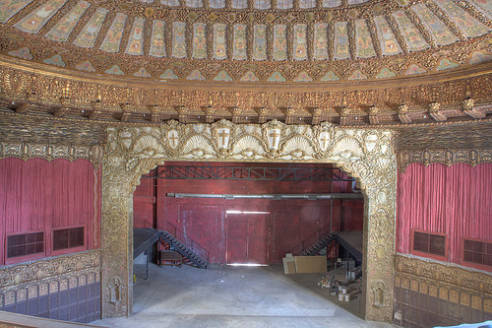
The Belasco Theater opened in 1926 with a run of the play "Gentlemen Prefer Blondes," by Anita Loos. One of the operating partners was Edward Belasco, but the theater was actually named after his more famous brother, the stage producer . The building was in the style, and most of the building's amazing detail has survived well to this day.
The 1926 Belasco wasn't the first Los Angeles theater by that name. In 1904 Frederic Belasco, brother of both David and Edward (there were eleven siblings in all), opened a 1200-seat theater at 337 S. Main street that featured a stage seventy feet wide and thirty-eight feet deep. It hadn't taken long -- the entire building was constructed in ninety days. As the new Belasco opened and the theater scene shifted south, the Main street theatre was renamed the Follies and became a strip-tease.
Heading Downhill
The mid 1940s saw the start of tough times for the Belasco. The theatre was very briefly shuttered in 1945, and then reopened by Arthur Grossman. In 1948 the venue was sold, and the content changed with the ownership. The new format was to show films preceded by a stage show or revue, typically featuring scantily clad girls. The revue in February of 1949 was titled "Peek-a-Boo", while in April they introduced "Good Nudes for All." The theater's last film double bill in 1950: "French Nudists" and "Girls for Sale."
Life as a Church
June of 1950 marked a major change as the building was bought by the Immanuel Gospel Temple for $200,000 ad converted to a church. Dedication services were held on June 11, 1950. Signage from this era of the theater's life can still be found on the south side of the building. At the front is a large sign reading "Prayer changes things," while at the rear is a much smaller sign for the church.
In 1973 the building was purchased again, this time for $300,000. The new owner was the Metropolitan Community Churches, a denomination founded for homosexuals (as the Times put it in a 1982 article). They owned the building until 1985, when it was put up for sale at $2.1 million.
Next Chapter?
Despite surviving in very good condition for so long, the 1990s saw the building suffer what's typically considered a death blow for theaters: its sloping floor was flattened with a concrete pour. Other than that, the building's in great shape. A sprinkler system was installed to bring the building to fire code, but it would appear that very little damage was done to the historic decoration.
It's not clear what the theater's next act might be. The most likely buyer would be a club with the money to build a theme around the structure's history. While there's no price given on the listing, the tag has certainly gone much higher since that 1985 listing. Any buyer would need the funding to purchase the building and to still have enough left over to make improvements once inside.
The situation of the Belasco is both similar to and different from that of Downtown's other theaters. Like the Broadway venues it's an amazing building looking for new life, but it's also in a more isolated location. On the positive side, it's in much better beginning shape than many of the Broadway edifices.
For me, the big thing is just that a great space like this return to being open to the public. We need these great old buildings to shine inside of being locked up for movie shoots and special events. As long as the use that comes in is available to the public and honors the building's history, it's fair game to reimagine what the space might be.








Walmart drew Downtown protests, but why...
Construction begins on $72 million bus...
Construction begins on $72 million bus...
Construction begins on $72 million bus...
Donated collection of maps is like 'Christmas...