blogdowntown
Not currently logged in. [Login or Create an Account]

Stay Connected


Trip to San Diego Shows the Value of Planning
By Eric Richardson
Published: Monday, August 25, 2008, at 11:28AM
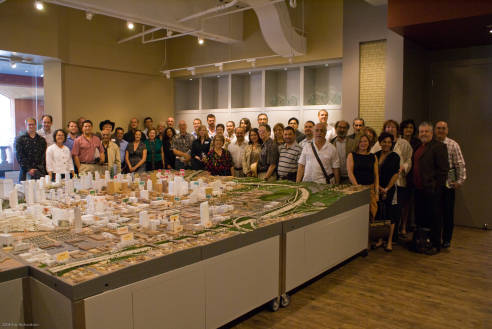
Bringing Back Broadway SD Field Trip Group Shot Eric Richardson []

The Bringing Back Broadway group poses for a photo next to CCDC's model of downtown San Diego.

What can the redevelopment of San Diego's Gaslamp Quarter teach us about how to foster Broadway redevelopment? That was the question that a group of more than fifty stakeholders from Downtown Los Angeles set out to answer last week, taking part in a two-day trip organized by the Bringing Back Broadway effort.

While there were plenty of options for good conclusions to take away, perhaps the most important theme was the value of a strong planning process.

A major issue to revitalization in Downtown Los Angeles is the time and uncertainty involved in opening any sort of a business that requires a Conditional Use Permit (CUP). It can often take a new restaurant or bar a year to get the necessary permissions to open.

For a new business, that delay can be a killer. How is a new restaurant, for instance, supposed to pay rent on a space for a year when it has no money coming in? Even more, how can it be expected to do so if the CUP isn't a sure thing? The uncertainty creates a situation where opening a business in Downtown Los Angeles has an uncertain cost, and that makes it harder for those who would open businesses to find backers, get spaces, etc.

Consider the cases of the Pacific Electric and Santa Fe Lofts, both at the corner of 6th and Main. PE Lofts applied for six liquor licenses in May of 2006. The licenses were granted without much fuss. The Santa Fe Lofts applied for a similar mix of permits in July of 2007, and its applications were rejected, due to political whims and a zoning administrator who had a different plan for the neighborhood.

In San Diego, three planning tools create a far different landscape for those who would wish to start businesses.

First, San Diego has strong community plans. Whereas Los Angeles' Community Plans have traditionally been extremely generic, San Diego's Downtown Community Plan offers much more fine-grained detail on the sort of uses and the type of development that should occur in each of its neighborhoods. Additionally, the "Gaslamp Quarter Planned District" has even more specific rules on design and usages.

Second, a Master Environmental Impact Report (EIR) was done for the Downtown region. This cut the timetable for new development by taking a step out of the process and giving an incoming developer a clearer sense of what mitigation would be required for the project.

And finally, approval responsibility for most projects Downtown was handed over to CCDC, with only appeals going to the city's Planning Commission and City Council. Again, this streamlined the process of development and reduced the number of meetings and approvals that a project would need to get in order to commence.

This final step was only possible thanks to the first two. Having clear rules for what was and wasn't allowed reduced the complexity of the approval process. The City Council and Planning department were heavily involved in the plan development, and were then able to allow CCDC to take charge in implementation.

These planning documents have the effect of making development and business planning a much more straight-forward endeavor, offering a checklist that a project must meet and allowing certainty about the acceptability of a project.

The bottom line? Where it can take a year to get approvals here in Los Angeles, the process takes perhaps three months in San Diego.

Here in Downtown we've taken early steps toward some of these items. The Planning department is in the process of redoing many of the city's Community Plans, and Planning head Gail Goldberg has brought this eye toward plan detail with her from San Diego. The Downtown Center BID has been working with the city on a blanket CUP to cover 7th street, hoping to drastically simplify the approval process on a street the group hopes to see turn into "Restaurant Row."

SHARE:

||

Related Topics


Topic:
Bringing Back Broadway

16 stories


Related Stories:


Conversation

Guest 1

With_An_E on August 25, 2008, at 03:42PM – #1

Great post. The negative impact of the absurd CUB process cannot be understated. I have a lot of experience processing new and trying to clean up existing CUBs, and aside from the incredible amount of work that a new one can require (consulting fees over $30K for the application- thats land use consultant, lawyer, architect, so on- plus the cost of an ABC license), they can be even more complicated even if there is an existing CUB (plan approval for which is still 3-6 months and nearly as expensive). Small entrepreneurs should be encouraged by every means possible, and they are the lifeblood of rejuvenating neighborhoods.


Guest 2

Feedup on August 25, 2008, at 04:51PM – #2

The City should also work with the County to fast track the Health Department paperwork. Here's another department that takes a long time to give an approval.


Guest 3

LAer in CA on August 26, 2008, at 01:00AM – #3

Truly a major disgrace! The (supposedly) larger city of Los Angeles has to take quite a few lessons from its southern neighbor. The ideas, examples and suggestions learned at the meeting in San Diego are no-brainers. Such things should have been thought up and implemented by Angelenos a long time ago. So why haven't they?

I was driving on the Santa Monica Freeway a few days ago, noticing the immediate views from around there, stretching from around the convention center east to the AT&T building. The sense of downtown one gets from that particular angle is not good. The impression one has of Los Angeles in general from such vantage points is that it is an utterly ugly and decrepit city, save for a few nicer buildings visible in the distance. What's unnerving is that it's not even as bad as it was several years ago.

So, for comparison, is any major wide-angle view of the landscapes of San Diego or San Francisco, as seen by people driving (or walking) through those two cities, similarly bad? Not that I'm aware of.

Now that San Diegans are getting their town spiffed up, and San Franciscans' continue to witness their city being treated as a lovely place, the city in the middle, Los Angeles, runs the risk of getting tossed out with yesterday's garbage.


Guest 4

the MIKE on August 26, 2008, at 03:30AM – #4

I read somewhere that the Sante Fe lofts, Bottle Rock, etc… were being denied liquor licenses last year. Any update on the city/zoning’s stance on this issue. I would hate for there to be any factors discouraging development in downtown. I just hope Charlie O’s, the Crocker club, the Stock Exchange Club, and the numerous planned restaurants to continue to spring up around downtown and the historic core. Can you write an article to update everyone on this pressing issue of development? Are homeless advocates still trying to expand skid row? Any information on continued development, liquor license applications, restaurant openings would greatly be appreciated.

The historic core is quickly becoming a very hip/interesting area and I would hate for that momentum to be stopped.

http://blogdowntown.com/2007/09/2861-hearing-to-decide-the-balance-of-a-neighborhood


Eric Richardson () on August 26, 2008, at 08:08AM – #5

MIKE: The followup to that story you linked to was that the Planning Commission meeting went much better and things started moving forward. Licenses are still moving their way through the system -- part of one of the Santa Fe licenses was at Council early last month (bottom of the page; Council approved that item).

There's no massive roadblock in the system like that precedent would have created, but the system's still just glacially slow.


Guest 5

Go Los Angelese Card on August 26, 2008, at 08:15AM – #6

It makes me sick when see these larger cities that make it virutally impossible to grow with having all their gears grinding against eac other. Too many politics in the mix.


Guest 6

Jeremy R on August 27, 2008, at 09:58AM – #7

Don't we have SD's old planning guru that catapulted the gaslamp quarter.

Why the heck don't we just listen to her!?!


Eric Richardson () on August 27, 2008, at 10:45AM – #8

Jeremy: Yes, we do. She's the one who put together the agenda for this trip. I made that clearer in the preview than I did in this story.

Bottom line is that it takes time to reshape the kind of bureaucracy we're blessed with.


Guest 7

Dana Gabbard on August 27, 2008, at 12:17PM – #9

As someone who has witnessed San Diego's downtown revitalization progress via attending Comic Con since the late 80's, I'd caution that these things take time and nurturing. And I am unsure if Gaslamp is necessarily a success to emulate--it is a very upscale insular culture that keeps it going, young party types with no room for ordinary folks or any wallets that contain less than a titanium card. Old Spaghetti Factory abandoned it a few years ago, taking the last affordable place to eat there with it. Little Joe's, the local neighborhood pizza hang-out, a few years ago went upscale and I am told took a dive in quality. Pricey condos, snarled traffic. But does have a spiffy Ghirardelli shop, the only one in Southern California...


Eric Richardson () on August 27, 2008, at 01:22PM – #10

Dana: Not disagreeing, but just an interesting note... The family that owns Old Spaghetti Factory still own the restaurant in that location (Dussini). I believe it's a concept they may expand elsewhere.


Guest 8

Juanito's Synopsis on August 27, 2008, at 05:15PM – #11

In contrast to San Diego and Santa Monica, Downtown is not (of course) ocean adjacent. However, it has the advantages of far greater complexity and density than those urbs, not to mention contradictions. Never the less, it is in need of a unique element to tie it all together - jewelry, toy, fashion, produce, J-Town, C-Town, K-Town, Culture Row, The Nickel, Convention Center/Live, Government Center, Bunker Hill, Financial District, Historic Core, Flower Mart and the ArtLoft Zone. Perhaps a singular, unique, symbolic object might tie these elements together and symbolize the city as well. I think that this object needs to be situated on the southern flank of downtown, specifically on the Hope Street axis.

Set in a fantastic garden at Pico and Hope, it would relate directly with the Central Library tower, the one element that has long given point to Downtown. It would point towards the Pacific as well - south by southwest.

After 'The Grand' and 'L.A. Live' are complete, what next Ms. Councilwoman?

As Asa Briggs once said of London: "To grasp in the eye in all of its incongruous integrity, at a single glance - to take, as it were, an angel's view of that huge town where perhaps there is more virtue and more iniquity, more wealth and more want, brought together into one dense focus than in any other points of the earth."


Guest 4

Angeleno on August 27, 2008, at 08:00PM – #12

I wonder if small businesses downtown are discouraged by the masses leaving downtown after 5p. Even with the recent rejuvenation of downtown, the place is desolate after 5p. This is a chicken and the egg dilemma where residents won't move in without amenities like restaurants but restaurants won't open without enough customers.

The San Diego gaslamp is completely different without thousands already walking downtown on any given day not including fans after a Padre game.


Eric Richardson () on August 27, 2008, at 09:20PM – #13

Angeleno: It's different now, but it was perhaps in even more dire shape when the Gaslamp redevelopment first started. That was an area you simply did not go to.


Guest 9

Richard Layman on August 28, 2008, at 10:44AM – #14

Lessees shouldn't sign leases that require them to pay rent before CUPs/Certificate of Occupancy is granted. You're right, the cash outflow period without any income to counter, during the approval and buildout process generally kills small businesses.


Guest 10

whitman lam on August 28, 2008, at 11:37PM – #15

The Urban policies of Los Angeles need to be completely overhauled ASAP. There is just no growth in this city because the permit process is too complicated, and there are too few personnel handling these permits. Yes, we do fall behind San Diego, New York, San Francisco, Chicago, Denver, in creating individualized neighborhoods.

I want to see real historic preservation zones, not just individual historic buildings. I want to see pedestrian-friendly zones with wider sidewalks, smaller building setbacks and less parking per square foot. An outdoor food market zone. Maybe even a red-light district ? This "One Size Fits All" standard of planning, ultimately "Fits Nobody".


Add Your Voice


In an effort to prevent spam, blogdowntown commenting requires that Javascript be enabled. Please check your browser settings and try again.


blogdowntown Photo Pool

Photos of Downtown contributed by readers like you.

Downtown Blogs


Downtown Sites


Elsewhere