blogdowntown
Not currently logged in. [Login or Create an Account]

Stay Connected


Students Offer Ideas for Future of Pico
By Eric Richardson
Published: Tuesday, December 16, 2008, at 09:50AM
Pico Presentation Eric Richardson []

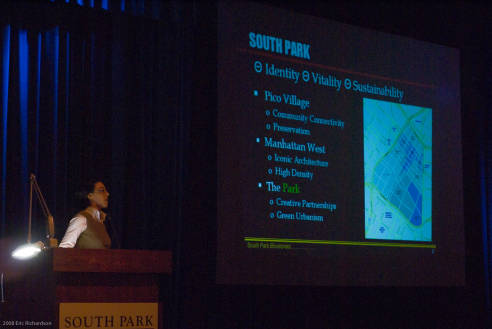
Lisa Herbst presents future possibilities for Pico Boulevard on the AT&T Center on Monday evening.

Eighty percent of the development rights around Pico Boulevard in South Park remain unbuilt, according to a presentation Monday evening by students from USC's School of Policy, Planning and Development. The session was the result of a project done in the spring, which produced three proposals for a master-planned redevelopment centered on the street.

While South Park has seen a good deal of new development, almost all of it has occurred above Pico. The students' proposals took a wide-ranging look at the neighborhood, considering existing infrastructure and uses while looking at different ideas for the future of the street. The group produced a 120-page report laying out current conditions and the three development proposals.

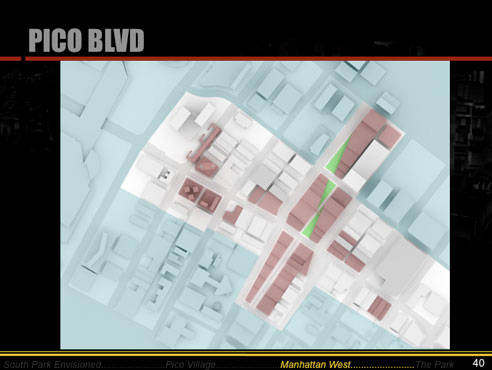
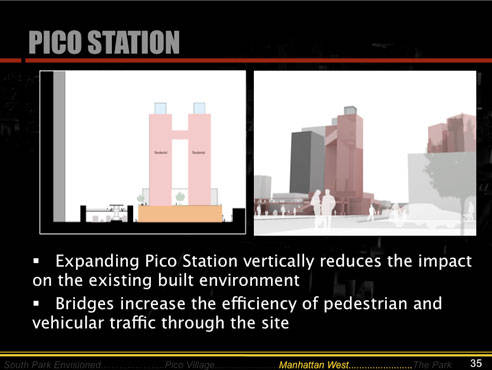
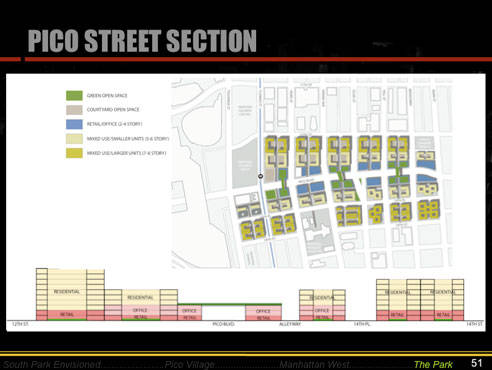
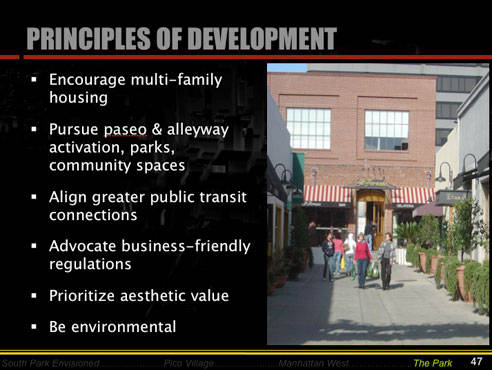
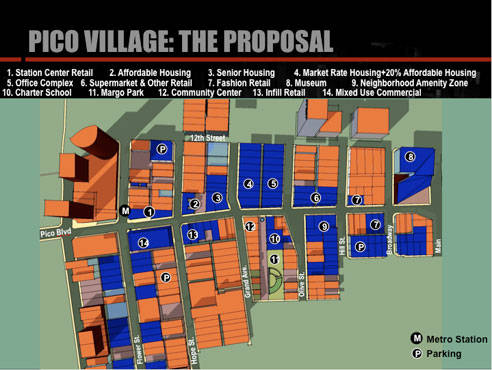
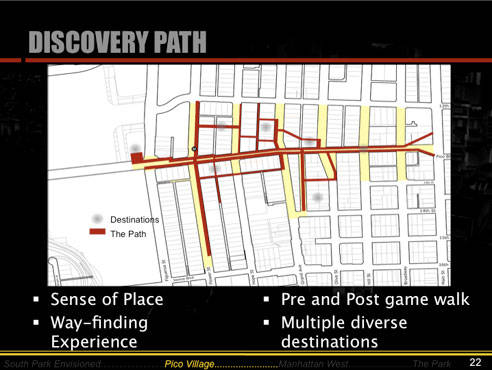
The Pico Village proposal laid out a mix of uses along the street, with mixed-income housing, a museum and connections to the Metro station on Flower. The Manhattan West proposal focused on density, but set out to avoid typical urban canyons by stepping back building heights. The first thirty feet in from the street would be limited to approximately two stories, with buildings rising to full height back from the street. The Park offered a heavy focus on green space, encouraging multi-family housing in dense but shorter buildings.

South Park Stakeholders Group head Mike Pfeiffer, who helped organize and oversee the project, said that while the proposals may not be buildable as presented, they play an important role in helping to create ideas that might be implemented in the neighborhood. The proposals are the "grains of sand to get the pearl finally to come forward," Pfeiffer said.

At the end of the evening, the students offered suggestions for first steps to move Pico forward. They promoted a focus on infrastructure and public improvements and a reworked approval process that would make development and business growth easier.
SHARE:

||


Conversation

Guest 1

Raymond on December 16, 2008, at 11:47AM – #1

with just a 2 story cap?? thats it? I think they definitely need to go back to the drawing boards with that one lol, but good start though with all the greenspace (more park space please), multi family housing, and portal to Pico Station. However I think it should be permitted to have maybe a 25- 50 story cap with minimal podium designs and with 20-30 max foot sidewalks no wider.


Eric Richardson () on December 16, 2008, at 01:39PM – #2

Raymond: The idea was a two-story podium that fronted the sidewalk, with the buildings rising to full height thirty feet back.


Guest 2

The Dude on December 17, 2008, at 12:09AM – #3

Agreed with Raymond; the frontage should go for 3-4 stories before stepping back. 2-stories is soooooooo short.


Guest 3

John Crandell on December 17, 2008, at 02:38AM – #4

Having only read this one post, I'm left wondering in regards to urban design considerations beyond landuse, density and frontage heights. There are two specific conditions unique to the locale that ought to be paid attention to. One is the grid shift, the slight change in the orientation of the street grid north of Pico vs. south of Pico (Pico was the southern extent of Ord's 1849 survey). The other condition is the preeminence given to the Hope Street corridor by the architect of the Central Library, his massing of the library's tower and centering it on this street's centerline. It is one very significant monument, much like the ferry building at the foot of Market Street in San Francisco.

The colliding point of the Hope Street Axis and the grid shift at Pico provides downtown with a unique opportunity for urban design. Might we envision one very particular urban place which would respond in design terms to the library tower and provide a symbolic element for South Park and for downtown? Perhaps even the entire city/metropolis?

Civic identity: whether South Park or all of L.A., let's take urban design considerations for this particular place another step higher. Much higher.

I mean really, does L.A. Live represent L.A.? We can do much better.


Guest 4

greensmark on December 17, 2008, at 08:10AM – #5

I am in agreement with Mr. Crandell. As we move forward with revitalizing Downtown, let us look at it as a complete city. We really can do better than just to have a series of entertainment complexes connecting one neighbourhood to another. Indeed, a City that rises above everyone's expectations of what Los Angeles is really about. Can you imagine WALKING in LA?? I do now! It's wonderful to envision how it will look 25 years from now. Monorails, Metro, People Movers?


Guest 5

seb on December 17, 2008, at 08:44AM – #6

I want to see renderings


Guest 6

eric on December 17, 2008, at 03:10PM – #7

what are the chances that something gets going here in the next two or three years? isn't there a family complex planned for pico / hope?


Eric Richardson () on December 17, 2008, at 04:09PM – #8

It never tells the full story to just show renders without context, but I've added two slides from each of the three proposals.


Guest 7

Bert Green on December 17, 2008, at 06:34PM – #9

The Manhattan West proposal talks about pedestrian bridges. Yuck. That's the best way to kill a street, look at Figueroa near 3rd. Nobody walks there. Not at all like Manhattan. I guess it has something to do with being car-centric. Yuck again.


Guest 3

Juanito on December 17, 2008, at 07:35PM – #10

Policy is planning. Planning is policy and unfortunately, as shown by the drawings, the school curriculum revolves simply around development for development's sake. Too bad the students in the architecture and landscape programs could not have been involved in this as well (if they were, very little evidence is shown herewith).

Already in downtown, we have been given the glorious, Orwellian 'pedways', one and six stories above the sidewalk. Now we are to have our green space elevated three stories. Will admittance be by card key only? The weight of soil sufficient to grow sizable plants and trees would make for a heavy support structure, making the green space extraordinarily expensive, per square foot basis. A developer would wish to receive a CRA subsidy to pay for this. Powers that be at the university's school of real estate have long excoriated efforts in downtown redevelopment. Go figure.

Imaginative urban design needs to be the driving force on the southern flank of downtown. Simply reflect upon the name Hope Street as well as it's unique aspect. And year after year, decade upon decade we are presented with various schemes for development for development's sake. If conceived rightly, this corridor (in combination with Pico Boulevard) could become a catalyst, counteract to some degree the coming recession in development.

These two avenues could present the city with something quite unprecedented. Imagine that.


on December 17, 2008, at 09:44PM – #11

Any concept that has NY/Manhattan/Times Square of the West as a moniker, in any part of a proposal, should be considered an idea made of "grains of sand" that will produce a fake pearl.


Guest 7

Bert Green on December 17, 2008, at 11:20PM – #12

True, Ed. It's actually somewhat embarrassing when I hear people trying to cram LA into New York cliches.

But remember everyone, this is a student exercise. None of this would ever get built as is.

While it is always fashionable to master plan whole swatches of urban territory, the best kind of urban evolution happens when it is organic, and does not involve some overall scheme for large scale demolition of an entire neighborhood. This is why the Historic Core blows LA Live away. It's a real place, messy, untidy, chaotic, and not master planned. A lot of individuals get to try their hand at making a go of it, rather than being directed by some distant billionaire.


Guest 8

Tony Baloney on December 18, 2008, at 10:03AM – #13

Bert: What you enjoy today about the Historic Core is directly related to a "Plan" and not the result of organic urban evolution. Planning policies and big money created the urban bliss that you reveer today.

In my opinion the real benefit of lofty student concepts is not the ideas they hope to advance but the provocative dialog they actually encourage. The messy task of building a city is truly left to those naive enough to believe they can make a difference. Creating environments people enjoy is a strange combination of planning,chaos, and chance.

The only real opinion that counts is the city resident of 2108, and their view of what you and I, those idealistic students, and those pesky billionaires manage to leave them.


Guest 9

Juanito on December 18, 2008, at 01:01PM – #14

Planning policies and big money applied to the existing Historic Core context has given us the bliss, Baloney Dude. And it is that existing context which Bert has spoken so well of.


Guest 10

Jerard on December 18, 2008, at 03:03PM – #15

With all this context of pathways and pedestrian movements, they consider adding a pedestrian bridges to the Pico LRT station instead of taking a page from Calgary's LRT where an additional at-grade platform was added and connected to their Convention Center.

The elevated platform doubled as added sidewalk space AND served as the main entrance to the building. This improved the walkability in the area and help create an anchor to one side of the Calgary's Transit Mall and improved the ridership of the station.

Also these series of pedestrian bridges or gardens over Pico Blvd within close proximity of each other disrupts the horizontal flow of pedestrians. At the one end of Pico there's the Convention Center with it massive structure over the street that should create the focal point to allow the things on Pico to visually flow through to the Convention Center.

With the context of definining a corridor and pathways, why weren't alternative solutions such as extending the proposed streetcar or linking this with the Fashion District made clear because during Fashion Weeks there could be a defining axis between Convention Center, South Park and Fashion District.


Guest 11

Bert Green on December 18, 2008, at 03:37PM – #16

"What you enjoy today about the Historic Core is directly related to a "Plan" and not the result of organic urban evolution. Planning policies and big money created the urban bliss that you reveer today."

Not true. There was never a city "Plan" for the Historic Core. The only major city action was the adoption of the Adaptive Reuse ordinance. There were no changes in zoning, traffic, parking, land use, etc. The renovations were undertaken by small developers who in some cases had to obtain variances to do their work. There was no wholesale demolition, no large zoning revisions.


Add Your Voice


In an effort to prevent spam, blogdowntown commenting requires that Javascript be enabled. Please check your browser settings and try again.


blogdowntown Photo Pool

Photos of Downtown contributed by readers like you.

Downtown Blogs


Downtown Sites


Elsewhere