blogdowntown
Not currently logged in. [Login or Create an Account]

Stay Connected


Mayor Touts Green Corridor, but Can Downtown Support His New Industry?
By Eric Richardson
Published: Tuesday, April 14, 2009, at 06:35PM
Arts District Eric Richardson []

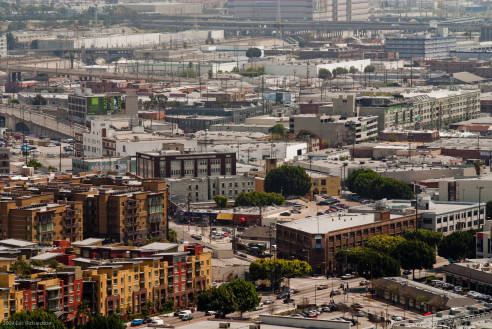
Looking southeast from City Hall over Downtown's Arts District and Industrial District.

In his State of the City speech this afternoon, Mayor Antonio Villaraigosa promoted the creation of a five-mile "CleanTech Corridor" that would stretch north through Downtown's Industrial District. The project would "transform our industrial core into ground zero for green jobs," Villaraigosa said.

Unsaid, though, is just how the city plans to turn antiquated industrial land with small plots into space that would support new green businesses.

The industrial land between the Downtown core and the Los Angeles River was laid out in the early 1900s. Lot sizes are small and the streets are even smaller. Railroads were the lifeblood of industry, and the grid of buildings and streets was built to support boxcars, not semi-trucks.

While the industrial district has a number of great old buildings, most of them are simply unsuitable for industry today. Low ceilings make manufacturing impossible, and lots lack the loading docks that business demands.

Villaraigosa said today that he wants to see a day when "clean technology is as synonymous with Los Angeles as motion pictures." He hopes to create a "business corridor bringing together researchers, designers and manufacturers from around the world dedicated to sustainable solutions and to creating green-collar jobs."

The Community Redevelopment Agency (CRA) has been pushing the Mayor's agenda for industrial CleanTech, , the southern anchor of the proposed corridor.

Discussions that mix the 20-acre site, formerly the Crown Coach school bus factory, and the small plots scattered through the Industrial District do a disservice to the conversation.

The Crown Coach site is an empty parcel of land, able to be shaped into whatever use one might want to put on it. The rest of the land along the river is a maze of tiny parcels and tiny blocks. Assembling large chunks of land is lengthy at best, and often simply infeasible. Infrastructure such as power and communications is also outdated and would need to be updates for more current users.

One would be hard-pressed to find evidence that a cash-strapped city can offer the incentives necessary to get new industry interested in such complicated land. In the meantime, the single-focused push has put a stop to other creative uses that find the funky layouts appealing. While a push for green jobs is nice, stifling potential development isn't.

SHARE:

||

Related Topics


Topic:
Industrial Land Use Policy

19 stories


Related Stories:

See Also:


  • http://latimesblogs.latimes.com/la...sas-state-of-the-city-speech.html


Conversation

User_32

Rich Alossi on April 15, 2009, at 01:37AM – #1

I agree that "green manufacturing" may not be the solution to fill up these industrial buildings (many of which are occupied by boxes and other bulk materials waiting for distribution) - but not all "green jobs" necessarily include manufacturing and assembly.

Research, "green training," and even architecture firms could be lured to the area.

As far as development goes, though, it's apparent that Skid Row will always be where it is now, in the heart of Downtown, and the industrial district will always be industrial (based on stated policies), and residential uses are unlikely to spread east from South Park very far because of the generally booming fashion industry (despite the recession).

See where I'm going with this?

Even if the industrial areas were allowed to be converted into residential use, you're still building two separate "downtowns," one on the east side and one on the west side/central.

The dream of a truly cohesive island of urban living in Los Angeles is pretty far-fetched these days, unfortunately.


Guest 1

Bert Green on April 15, 2009, at 11:03AM – #2

I see your point, Rich, but I don't see it as so fragmented. It's not a bad thing that downtown has different uses in different zones, but what it lacks is strong transit connectivity.

The proposed Green Tech corridor is just south of Union Station. How about extending the Red or Purple Line south along the river (the tracks are already there in some places) to serve this new project area. Workers and customers could get there on foot. That's green.

With the proper incentives, firms could relocate here, but to assume only a truck-based model is not green. The Alameda Corridor freight line is adjacent to this site. That can provide freight access and easy port access, no trucks needed.


Guest 2

tim o'connell on April 15, 2009, at 02:44PM – #3

The nonprofit Apollo Alliance group Phil Angelides leads just sent out a message that was pretty discouraging. The point is, and our green energy future is currently dependent on overseas manufacturing. If we are going to get the jobs and economic stimulus of green industry, then the funding has to have a strong "Buy America" provision, or the energy companies are going to spend the money where the wind turbines, solar panels and other green energy stuff is made - and that isn't Detroit.

Even Robert Hertzberg, once Speaker of the California State Assembly, went to Wales to start up a photovoltaic manufacturing plant instead of South LA or someplace else in the US.

Whether another ex-Speaker can pull it off - well, I will wait and see, but I hope he is ready to roll up his sleeves and stick to it for more than one press conference and photo-op.


Congress is about to make the biggest investment in clean energy and green jobs in history. But will all those new jobs stay on American soil, or will they go overseas? Congress should be creating new jobs right here in America where we need them. But unless we act now, the new energy bill could end up pouring money into other countries' economies.

We've created a highly effective TV ad to hit key senators where they live – literally. We're starting with Ohio Senator George Voinovich, whose swing vote could make or break this bill.

Watch our new TV ad. If you help us get it on the air, your gift will be DOUBLED by a generous donor.

The energy bill is moving...fast. And it will generate unprecedented demand for clean energy technologies. That demand could create millions of jobs in America. But there's one big problem: we don't make most of the clean energy systems and components here in the U.S. Fully half of America's wind turbines were made overseas.

We MUST retool factories and retrain workers so we can take advantage of this new market. Otherwise the energy bill will actually create new jobs overseas, even though we have the know-how, the facilities, and the hard workers right here. America can't afford that. That's the message of our new ad – and it's one that Senator Voinovich needs to hear.

Help us get this ad on the air, and a donor will match your gift, dollar-for-dollar.

We can't waste this chance to get American families back on solid financial footing.

Thanks for watching our new TV ad – and for all your support.

Sincerely, Phil Angelides Chairman The Apollo Alliance

Apollo Alliance • 330 Townsend Street, Suite 205 San Francisco, CA 94107 Ph: • Fax:


To see the advert, go to


User_32

Rich Alossi on April 15, 2009, at 03:01PM – #4

Great point, Tim, and it's one that's overlooked many times.

It's the same concept as a LEED-certified new building. It might incorporate 'green' principles, but it still takes much more energy and resources than a conversion of an existing building would be.

South LA and the South Bay have lots of open space and easy access to the ports and national rail infrastructure, and would benefit greatly from some of these manufacturing, assembly and distribution jobs.


Jack Skelley on April 16, 2009, at 10:28AM – #5

No reasonable person denies a "green" economy is pivotal to recovery. But pigeonholing the economic revitalization potential of the Industrial District as a "green district" mis-characterizes the many jobs that can be created here in live/work spaces, and which already exist.

And they don't need huge parcels: fashion designers, web designers, printers, graphic artists, real estate brokers, non-profit arts groups... all working out of home offices. they are already transforming the District and supplanting the "industrial" jobs.


Guest 3

David Kennedy on April 17, 2009, at 09:35AM – #6

I'm no economist, but this article about Madrid's experience is food for thought.

http://online.wsj.com/article/SB123992109862226959.html


Guest 4

David Kennedy on June 25, 2009, at 03:11PM – #7

Here's another interesting article on this topic with some very helpful links.

http://www.washingtonpost.com/wp-dyn/content/article/2009/06/24/AR2009062403012.html?hpid=opinionsbox1


Add Your Voice


In an effort to prevent spam, blogdowntown commenting requires that Javascript be enabled. Please check your browser settings and try again.


blogdowntown Photo Pool

Photos of Downtown contributed by readers like you.

Downtown Blogs


Downtown Sites


Elsewhere