blogdowntown
Not currently logged in. [Login or Create an Account]

Stay Connected


Little Tokyo Asks Metro to Study Grade-Separated Alternative for Regional Connector
By Eric Richardson
Published: Wednesday, October 28, 2009, at 02:16PM
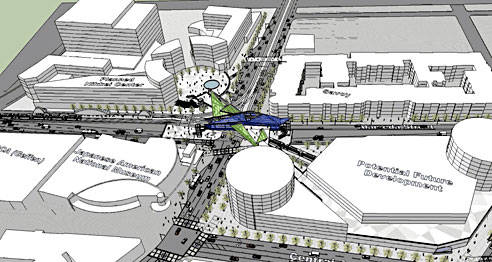
Conceptual Design for 1st & Alameda Metro

To mitigate traffic and pedestrian impacts at 1st and Alameda, Metro has proposed a trench for truck traffic and a pedestrian bridge for walkers.

The Little Tokyo Community Council on Tuesday asked Metro to go back to the drawing board on the Regional Connector, the light rail link intended to connect the Gold Line, Expo Line and Blue Line.

The group asked Metro to study an option that would keep the line underground as it crosses through 1st and Alameda. A successful solution would clear many of Little Tokyo's concerns about the line and would eliminate a weak point in the project's design.

Officially, the Metro is still studying both above-ground and underground options for the Connector, but community meetings have been clear about the public's preference for an underground option.

Current designs have the line surfacing on the southwest corner of 1st and Alameda, crossing the intersection at-grade. That would require at least partial demolition of the block currently occupied by Office Depot, and would leave the center of the light rail network vulnerable to traffic accidents.

The crossing is necessary because of the design of the Gold Line Eastside Extension, which is set to open on November 15. The Little Tokyo / Arts District station was placed right at the corner of 1st and Alameda, leaving no room for the Connector to surface on that side of the street.

A write-up on Little Tokyo UnBlogged . That may be important. Any solution would require additional land to implement, and a supportive developer would make that possibility much more likely.

"In the beginning of the project, we had some parameters that made it more difficult," said Ann Kerman, Constituent Program Manager at Metro. "If we have a new envelope to work in, that's what we're going to explore now."

It is unclear how a truly grade-separated option would connection to either the north, where the Gold Line enters an elevated ramp as it heads north from the Little Tokyo / Arts District station, or the east, where it runs along 1st street.

If a solution can be found that allows it within site and budget constraints, full grade separation is Metro's preferred alternative as well. "Our goal is to build something that's going to work for the community and also maximize the efficiency of our system," said Kerman.

The Metro board voted in September to submit the Regional Connector and the Westside subway extension to the Federal government for funding. The project is also a key part of Metro's Long Range Transportation Plan, which the board approved last week.

Another round of public meetings on the project will be held starting next week. On Saturday, November 7, the project team will be at the Wurlitzer Building (818 S. Broadway) from 10am to noon. On Tuesday, November 10, they will be at the Central Library Board Room from noon to 1:30pm, and on Thursday, November 12, the team will be at the Japanese American National Museum from 2 - 3:30pm and 6:30 - 8pm.

SHARE:

||

Related Topics


Topic:
Regional Connector

35 stories


Related Stories:


Conversation

Guest 1

Bert Green on October 28, 2009, at 03:18PM – #1

This would be a good thing if the MTA agrees to it. The 1st and Alameda solution is really ungainly as proposed. The worst part of it is the elevated pedestrian bridge. Just look at the elevated walkways along Figueroa St for evidence of how it kills the life of the area.


Guest 2

Lauren on October 28, 2009, at 03:46PM – #2

As a Little Tokyo resident, I've had mixed feelings about the Regional Connector. I strongly support public transportation, but an at-grade crossing at 1st and Alameda would be very bad for business and the community here. The designs for the overpass are unwieldy. We've already seen delays in opening the Gold Line East extension due to considerable safety concerns. Having so many trains crossing 1st and Alameda would lead to far greater safety concerns, even with a pedestrian overpass. Cars going east/west would be at the same grade as the trains in the current plans. Additionally, the trains and their tracks would become a physical barrier separating the Arts District from the rest of DTLA. I hope that Metro will seriously consider a grade separation for the Regional Connector at this crucial intersection. We need to improve public transportation options in DTLA and throughout Los Angeles, but not at the expense of local neighborhoods.


Guest 3

John Swartz on October 28, 2009, at 04:27PM – #3

We need a grade separation here at all costs! Having a railroad crossing at-grade in such a major retail and residential area would be dissaterous to business and extremely hazardous for pedestrians and traffic. Not to mention the rediculous traffic constraints it would add!


Guest 4

Tim on October 28, 2009, at 04:35PM – #4

Boy, there has been lots of good news here lately.

The present design for the connector is a mess. It reminded me of Commons Park in downtown Denver. It is a beautiful park just north of Union Station. But the train tracks cut the park off from downtown. And instead of thinking like Grand Central in New York 100 years ago, and burying the train tracks, Denver instead built a huge pedestrian overpass to link downtown and the park. Walking over the structure, you could only think of how much more use the park would get if it weren't so time consuming to get to.

This ugly pedestrian bridge cannot rise above Aladema. The train tracks must cross Alameda underground.


Guest 5

tornadoes28 on October 28, 2009, at 09:18PM – #5

Too bad Metro didn't think of these things before building the Eastside rail Little Tokyo station in such a bad spot.


Guest 6

Bert Green on October 28, 2009, at 11:29PM – #6

It will be quite a few years before the Connector is built, so the existing station will serve well until then. If it does happen that the 1st & Alameda connector goes underground, the existing station could be replaced pretty easily.


Guest 7

carter on October 29, 2009, at 08:51AM – #7

It is a big ugly mess as it is. Put it underground,.. put the whole connector underground. It will make it faster, more efficient, and far far less accidents. Especially in an area as dense as this.. just put the whole thing underground. It is more dense than the east side, and Gloria Molina now sees that the east side line should have been underground as well. I dont know why metro is so slow to really get this. http://www.latimes.com/news/local/la-me-eastside27-2009oct27,0,5845354.story


Guest 8

Jerard on October 29, 2009, at 10:06AM – #8

I wonder, how feasible it will be to replace the Little Tokyo station, if the Nikkei Center is approved and built BEFORE the connector ?

However some of the comments of the the trains greating a barrier between Little Tokyo and the Arts District, I respectfully disagree but Alameda traffic is a bigger barrier then the trains are.


Sebastian Mele on October 29, 2009, at 12:30PM – #9

If not underground put it above ground like a monorail


Guest 9

Juanito on October 29, 2009, at 01:06PM – #10

When this prospect was first raised, MTA responded that there wasn't enough distance along First Street east of Alameda - the distance between a grade separation from there eastward to Vignes & the bridge over the river - to allow for a proper gradient for the tracks. (i.e. - there is a maximum slope or gradient that the trains can run on and that there is insufficient distance for the track to come up to grade @ the Vignes intersection). So they said.

I wonder how this issue plays into the slope or existing surface grade along Alameda - from First Street north to the ramp over Aliso and the 101. In this latter case, you're going uphill UP the valley, whereas in the former case, you're essentially traveling flat ACROSS the valley floor.

Check out the slope of the ramp (Google Maps) as it curves east up and over Aliso, starting from grade only a few hundred feet south. That's quite some slope! Looks like the MTA was handing out BS.


Guest 10

gkam on October 29, 2009, at 03:34PM – #11

It's amazing to me that Metro is still keeping the above-grade alternative on the table. It needs to either be: 1. underground; or 2. deeper underground.


Guest 8

Jerard on October 29, 2009, at 04:26PM – #12

I remember the reasoning for originally kicking back then (Alternatives 6 & 8) was because of the impending Nikkei Center Project this would require that Metro purchases or leases the lot in order to perform the various tasks and that was out of the question in the developers eyes. If what is said is true the the Nikkei Developer is working with Metro to coordinate land/space issues with the design then this could very well work.

In addition, in order to build the portal to tie into the new tunnel would require a subsequent widening of First Street, again and the prevention of the expansion of Hewitt Street which would be right in the middle between Alameda and Vignes and it is subsequent neccessity in order for the Nikkei Center to have access for deliveries and parking.

Doing it very deep underground wouldn't solve any problems, it would create bigger ones because they'd have to tear down and rebuild the bridge over the 101 because there's not enough distance from maybe 40-60' underground.


Guest 11

Damien Goodmon on October 29, 2009, at 09:00PM – #13

Oh dear not the delivery access. ::scream::

Deliver access to a private development that hasn't even gone through the design phase was the justification for proposing an at-grade crossing for 44-48 trains per hour that with just one accident would have shut down 3 of the 5 rail lines on the entire Metro system (to say nothing of the other adverse impacts, i.e. Alameda trench, of the proposal)?

I tell you, Metro thinks of some of the most ridiculous reasons in the word to propose the most non-nonsensical things. The fact that people actually buy it - or expect people to be okay with it, is what gets me.


Eric Richardson () on October 29, 2009, at 09:49PM – #14

Damien: I hadn't hear delivery access, but I know one of the concerns was that a mid-street portal would require widening of 1st street, and there was significant concern that would impact the Buddhist Temple's site.

Mostly, though, it seemed like they didn't want to spend the money or tear out something they were still building, even if it should have been built different the first time.


Guest 12

Joseph E on October 30, 2009, at 12:26AM – #15

It is a shame that Metro will have to tear out a brand-new station, but burying the whole connector is the right choice. I am glad to hear that the Nikei Center developers want to help Metro do it right. Perhaps we can build part of the tunnels now in a cut-and-cover fashion before the Nikei center is built, and then finish the rest later when the feds approve the project.


Guest 11

Damien Goodmon on October 30, 2009, at 06:07PM – #16

It was Jerard who pulled the delivery access issue out of thin air, to which I was responding. It's a non-issue was my point. Simply design the access location elsewhere.

Regarding the Temple, there's plenty of feet to transition and be at grade by the time the tracks reach Garey (where the Temple begins) and thereby never touch the Temple's sidewalk. LTCC is right to be concerned. And you really have to know this stuff to be able to see through what Metro is saying is true to evaluate whether it actually is true.

For example, Metro will undoubtedly come back and say that the portal will need to be 700 feet, when it really only needs to be 525, traffic lanes need to be 12 feet, when it really only needs to be 10.5, and things of that nature. The reason this is done, relates primarily to your second point: Metro will go to great lengths to avoid admitting to their incompetence - especially with the feds looking on.


Guest 8

Jerard on October 31, 2009, at 01:11PM – #17

Delievery out of thin-air, That was explained back at the Alternatives Analysis about a year and half ago is to one of the reasons the alternates for this proposal were dropped.

Are there any builders or engineers in the audience?

Because access to a site is a central piece to getting ANY building built and then accessed when completed, because that limits the amount of temporary permits they need to get from the city for such things as concrete deliveries or concrete pours and from my memory these vehicles are not small. This little piece will limit the size and method of construction all of which has a cost attachment to it, because developers build to make money within the design limits of the zoning and building codes.

With Nikkei Center, they will extend Hewitt Street to Temple which currently ends at 1st Street. The answer of 'design the access somewhere else' is a wonderful non-response. Where will the developer design this access? If new/temporary tracks are cutting through a sizable piece of his development that limits where the access is placed. Which then limits the developers ability to build a project that pencils out. One design move will create a number of different questions and actions. To imply otherwise is not very wise.

With Temple, this is correct that this can be done at our we discussed this to a high level of design to understand what needs to be accomplished and how it can be done. What about at First Street? The street blocks are shorter along First Street compared to Temple-1st, so which streets need to be closed off to allow this new portal to come to grade level? Which streets could we take advantage of to close off to make it to grade level and if we do, which patrons abutting or fronting this new portal will accept this condition?

With a 6% vehicle grade(the maximum the LRV's can safely operate) it will take over 525-550' to come to grade from a depth of approx 25-30' below, this space doesn't include a small landing at the end of the portal. The deeper this space is below street level, the longer it takes to come to grade.

However the question remained at the time of discussion, what happens to the Nikkei Center development in order to either do a temporary or permanent station to enable Pasadena-East LA trains to operate during this construction. Will a developer work with this project to make it work? A key question that up until recently, the answer was no. Now that he's at the table, something could come from this.


Guest 13

Damien Goodmon on October 31, 2009, at 03:56PM – #18

If the train height (with pantograph and overhead wire) is 18 feet, why would the portal begin when it's 30 feet underground? Stated another way, why would a portal begin when the top of the tunnel is still 12 feet below the surface?

Of course it wouldn't, ESPECIALLY, if the primary objective is to design something to fit within the confines of the street grid.

As is customary, the portal wouldn't begin until the top of the tunnel is 4-5 feet below the surface - or stated differently when the bottom of the tunnel is 22-23 feet below street level.

Even at a 5% incline it requires less than 500 feet to make it to the surface (23 feet/0.05 = 460 feet).

Regarding other matters, Jerard (as you frequently do) you've wildly exaggerated the construction impact.

Permits? Give me a break. Like the private developer of the project can't be compensated for the inconvenience caused by the public project (i.e., reduction in time or fees for their project), to say nothing of what the economic impact of the proposal is in comparison to the alternative proposal, both in construction and in operation.

And you've spoken to the developer or the "patrons" have you?

Obviously, people had reservations with the 1st/Alameda underground alternative that compromised the entire Nikkei site. Metro has never proposed anything that was underground at 1st/Alameda that didn't require substantial acquisition of the Nikkei site. Perhaps it's because they too were making mountains out of mole hills, while simultaneously downplaying the impact of the 1st/Alameda crossing, primarily to keep face (i.e. not rip up the $7-8 million station).

Something like a single track shoe-fly and temporary 1st Street lane drop while the portals are created, with a temporary station on the portion of Alameda already within Metro's ROW. Metro has a good 40-50 feet from the platform edge to the property line of Nikkei - plenty of space for a 10' wide temporary platform and single track.


Guest 14

Ron on November 02, 2009, at 02:08PM – #19

Disclaimer: I work for Little Tokyo Service Center which is part of the Nikkei Center development team. A few points I'd like to make:

  1. Eric is correct, the biggest concern in the LT community re a portal on 1st Street was the MTA's determination that 1st would have to be widened again, most likely to the detriment of Nishi Temple.

  2. The Hewitt Street extension into the Mangrove site was to be the primary auto access point into Nikkei Center -- not just for service deliveries, but also for residential and commercial parking. If Hewitt could not be extended north of 1st, we'd have to look at auto access from Temple Street or a Hewitt cul-de-sac accessible from Temple, neither of which is optimal but less problematic than Alameda or 1st. We would definitely prefer a Hewitt extension from 1st to Temple.

  3. The development team is working with the community and the MTA to figure out a solution. We've participated in all of the community meetings and the lead developer on the team has also met with the MTA to discuss our willingness to accommodate a better solution. We and the LTCC would support an underground solution if it was not detrimental to Nishi or Nikkei Center. As Damien mentions above, Nikkei Center LLC would seek compensation from the MTA for loss of land, access and time.


Guest 15

Jerard on November 02, 2009, at 03:42PM – #20

Thank you Ron, for your input as you are seeing this as part of the project team.


Guest 16

James Fujita on November 03, 2009, at 10:41AM – #21

If the "Fifth Option" works, that's great.

However, if it doesn't end up working out (because of problems with Nishi Hongwanji or with the Nikkei Center or for whatever reason), I would hope that the LTCC and all of Little Tokyo would give the existing Underground Option a second look.


Guest 14

Ron on November 03, 2009, at 06:23PM – #22

Neither build option is popular with the LTCC. Nonetheless we (LTCC) continue to meet with the MTA to discuss each alternative and their impact. As a result of this ongoing dialogue, MTA is willing to consider hiring a consultant to assist the community in identifying potential mitigation measures. Interested parties should contact me at LTSC.


Guest 11

Damien Goodmon on November 03, 2009, at 09:50PM – #23

If the portal is located between Rose and Garey (blocking Hewitt) street widening of 1st is not required - at least as the street is configured today.

If it is pushed east of Hewitt, to be placed between Hewitt and Vignes, the two major impacts come from placing the portal in front of Temple and possible street widening to require cuts in the sidewalk even further. I say possibly, because I don't know the exact width of the southside sidewalk, nor the width of the vehicular lanes. They may have enough space to take from those two to provide some size to the portal, but I highly doubt it.

Now if the portal is placed between Rose and Garey, Hewitt would be closed to cross traffic, however it would be open to access from the westbound 1st St traffic (coming off the bridge), meaning people could still enter the site when traveling from the east, and could exit the site from Hewitt onto westbound 1st. Entering the site would have to come from Temple.

One potential idea is to locate the portal between Alameda and Hewitt, but the feasibility of that and the visual impacts of it is questionable.


Guest 14

Ron on November 04, 2009, at 05:55PM – #24

Damien: I've been told of an rough early study that has the eastbound portal on the Nikkei Center site that would completely block Hewitt, which is a terrible idea to me. A portal in the middle of 1st is more desirable depending on its impacts as you describe.

I suppose keeping First Street at 4 lanes is a given to LADOT. Not sure where the community would stand on that.


Guest 11

Damien Goodmon on November 05, 2009, at 08:05AM – #25

Ron:

You can see Metro's assumptions of the portals being on the Nikkei site in their options 6 and 8 Alternative's Analysis: http://www.metro.net/projects_studies/connector/images/faas_Section%202.pdf

Alt. 8 has the eastern portal (towards Boyle Heights) cutting right across the Nikkei Center property - it's totally unreasonable. Alt. 6 has the eastern portal on 1st (between Rose and Garey) in the middle of the street. However, both Alt. 8 and Alt 6 have the northern portal (towards Union Station) on the western part of the Nikkei Center site and clearly that's not a good thing. (See pgs. 36 and 40).

It seems that if Metro would simply work with Alt. 6 to place the northern portal at the current site of the Little Tokyo station (that way it's not on the Nikkei Center) they'd be further along in mitigating that concern. It's why I've begun to say the first step to Metro's recovery on the DTC is admitting they need to rip up the brand new station. Not that there aren't benefits to Metro of ripping it up (more reliable transit operations, faster traveling speeds, reduced maintenance costs, etc.)

Now, regarding the other issues, LADOT's desire to maintain 4 lanes may - emphasize MAY be an assumption for the current "underground emphasis" proposal not the totally underground Alt. 6 and 8. If it is for Alt. 6 & 8, I'd seriously question them about it.

If the 1st/Alameda crossing is put underground, it provides more room for westbound 1st Street traffic at Alameda to have: a dedicated left turn, a dedicated right turn, and two through lanes. Problem with the current Metro proposal is that it maintains the 1st/Alameda crossing.

As long as the portal isn't between Garey and Vignes, you can maintain the current number of traffic lanes and sidewalk widths - the train would remain unaltered in the portion at-grade (Garey to Vignes) and there's sufficient width to fit the portal between Rose and Garey. Metro may be assuming a portal width that is significantly greater than they need, which is leading to LADOT's statement to cut sidewalks and maintain 4 lanes or drop two lanes.

And to be clear, if the portal is under 1st between Rose and Garey it would allow right turns out of the Nikkei Center onto 1st (towards Little Tokyo) out of Hewitt, and right turns into the Nikkei Center from 1st (from Boyle Heights), but it would not permit through traffic across Hewitt, because of the portal.

Depends on how important through access on Hewitt is to Nikkei and Little Tokyo in comparison to the adverse impacts of the alternatives. That said cutting off through access on Hewitt AND taking property on the western edge of the property, is different than only cutting off through access and NOT taking property on the western edge.


Guest 14

Ron on November 05, 2009, at 11:24AM – #26

Damien: I'm familiar with Alt. 6 & 8. The "rough early study" I was referring to was a recent attempt at designing the so-called 5th Option. Sorry for not being more clear.

The issue on 6 & 8 is their impact on Nishi. Alt 6 seems possible if 1st Street widening was minimized and the north bound portal was under the existing station as you suggest.

I also understand the right turns available on Hewitt. Personally I would like to have a Hewitt that runs uninterrupted from the south side of 1st; I feel that will provide better site access to/from the Arts District. That said, this is probably less important than accepting an alternative that negatively impacts Nishi.


Guest 17

Damien Goodmon on November 05, 2009, at 12:44PM – #27

Ron:

So you know, one way MTA likes to exaggerate the width of the portal is by placing the emergency exit walkways on the outsides of both sides of the track. They can put it between the two tracks (where the pole is located) and save reduce portal width by 4-6 feet.

The travel lanes can also be reduced in width down to 10'. They may be assuming 11' or 12'.

All of this doesn't sound like much, but given my dealings with the MTA engineers, I can confidently say these calculations are often the difference between a bureaucrat dismissing an option or keeping it on the table. One bad assumption can mess everything up.

The width of the portal is important, but the length of the portal is even more important. Suffice to say at 5% grade a MINIMUM of 475' is needed, more likely 500' (22 feet/0.05 = 440 feet). I don't know if MTA has anything greater than 5% grade on their system, but if the do consider going up to 6% grade on the DTC (the maximum allowable grade of light rail trains) then the portal length can go down to 400' (22 feet/0.06 = 367 feet). I say portal length is more important than width because, worse comes to worse, if Nikkei Center is willing, Metro could buy a few feet of space from the Nikkei site along 1st (somewhere around 3-5 feet). I don't see the need to do that though. Right now I looks like they have the width even with 4 lanes. However, Nikkei Center/Little Tokyo may WANT that to provide Metro with that extra feet for more decorative treatment of the portal. But first my recommendation is to get them to putting the emergency walkway in the middle and reducing vehicular lanes down to 10 feet.

The place where there is nothing to give, as I understand is in front of Nishi, which is why you want that train at street level by the time it gets to Garey (when heading towards Boyle Heights).

I think its premature for me to say this (because I've yet to actually go out there and measure the street width between Garey and Vignes), but it looks like with an underground crossing at 1st/Alameda you either get through access to Hewitt or cut sidewalks at Nishi, but not both. The only way you get both is by locating the 1st St portal between Alameda and Hewitt.

Regarding Arts District connections, if Hewitt is cut off are there things that can be done on Rose, Garey or Vignes? Consistent pedestrian treatments, decorative signage, landscaping, etc.?


Guest 11

Damien Goodmon on November 06, 2009, at 07:48PM – #28

Important mistake. This sentence: but it looks like with an underground crossing at 1st/Alameda you either get through access to Hewitt or cut sidewalks at Nishi, but not both.

Should be:

but it looks like with an underground crossing at 1st/Alameda you either get through access to Hewitt or keep sidewalk widths at Nishi, but not both. The only way you get both is by locating the 1st St portal between Alameda and Hewitt.


Guest 14

Ron on November 09, 2009, at 10:57AM – #29

Thanks for the info. As for Arts District connections there are other streets to focus on, the best of which could be Garey. If the East Village project is built there would be a nice pedestrian link on Garey to what will hopefully be a green space next to Nishi.


Add Your Voice


In an effort to prevent spam, blogdowntown commenting requires that Javascript be enabled. Please check your browser settings and try again.


blogdowntown Photo Pool

Photos of Downtown contributed by readers like you.

Downtown Blogs


Downtown Sites


Elsewhere