blogdowntown
Not currently logged in. [Login or Create an Account]

Stay Connected


Metro Says Fully Underground Connector Feasible, Could Cost 20% More
By Eric Richardson
Published: Thursday, November 19, 2009, at 03:54PM
Regional Connector - Underground Map Metro

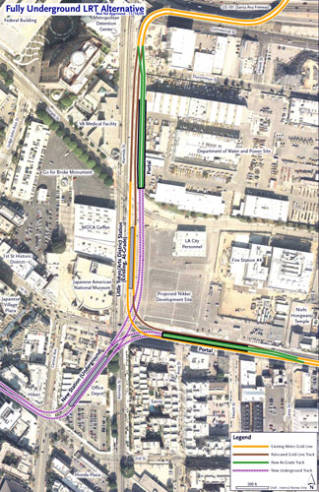
A rendering released today by Metro shows the routing that a fully underground Regional Connector might take.

Little Tokyo's call for a fully grade-separated Regional Connector has been answered. Metro today used its blog to unveil early engineering study results, which it then presented to a Little Tokyo working group meeting later in the evening.

The transit agency warned that the new configuration, which continues under 1st and Alameda below-ground, could add $200 million to the project's cost. That didn't faze community members, who voted to endorse further study of the new option.

The new option presents a significant change for the Regional Connector project, proposed to connect all of Metro's light rail lines and allow trains to run from Long Beach to Pasadena and Culver City to East L.A. At public meetings in late 2007 and early 2008, Metro staff was clear that the design of the Gold Line Eastside Extension precluded an option that would both be fully underground and have a Little Tokyo station.

While Metro has been studying what it calls an "underground-emphasis" option for the Connector, designs have shown the line surfacing on the block currently occupied by Office Depot and crossing 1st and Alameda at street level. That would allow it to connect into the existing at-grade station.

The new alternative would instead place a station underneath the Office Depot site, with trains continuing under the intersection as tracks split to emerge via portals along Alameda and in the middle of 1st.

The Alameda portal would be located north of Temple street, while the 1st street tracks would rise just east of Alameda, leveling off just past Hewitt. Some temporary track on 1st would allow the newly-opened Gold Line Eastside Extension to continue operating throughout construction.

The fate of the existing Little Tokyo / Arts District station would be uncertain. The underground tracks would enable trains to run from Downtown to Pasadena or East L.A., but direct service from Pasadena to East L.A. could only continue if Metro kept the above-ground station and tracks.

While the underground alignment was welcomed, construction impacts could still prove tricky. Both the underground station and the 1st and Alameda crossing would be built using cut-and-cover construction. That requires closure of the intersection as crews dig down far enough to erect a cap over the site and continue the work below.

Metro also needs a site to lower the twin tunnel boring machines into the ground. That's a 3-4 week process for machines that are 26-feet in diameter and 300 feet long. Likely sites are 2nd and Central or 2nd and Hope.

Along with making Little Tokyo stakeholders happy, the new alternative has benefits for those involved in Broadway revitalization. While stations at 5th and Flower and 2nd and Hope have been pretty firmly set, the third Connector station was to go either at 2nd and Broadway or 2nd and Los Angeles. With the fourth underground station, Metro would choose the Broadway siting.

Metro staff will now add the fully underground option as a third build alternative in the environmental process. Cost estimates currently range from $709 million for the above ground alternative to approximately $1.1 billion for the new option.

It will not be until the summer of 2010 that the Metro board chooses one option as the Locally Preferred Alternative.

SHARE:

||

Related Topics


Topic:
Regional Connector

35 stories


Related Stories:

See Also:


  • http://thesource.metro.net/2009/11...for-1st-and-alameda-intersection/


Conversation

Guest 1

peenee on November 19, 2009, at 06:54PM – #1

eric,

do you have a larger map of the regional connector with all stations mapped?

thanks

peeenee- the unlovable


Eric Richardson () on November 19, 2009, at 07:15PM – #2

You can find lots of Regional Connector information on Metro's site. Check under the Meeting Presentations tab on the right.


Guest 2

tornadoes28 on November 19, 2009, at 07:25PM – #3

The fact is is that makes sense regardless of the cost. What was previously proposed with the Alameda intersection made no sense. It was a mess.


Guest 1

peenee on November 19, 2009, at 08:08PM – #4

thanks, eric! i visit metro website often not sure how i missed this section. i like the underground idea too because the streets are just too busy especially during rushhour time.

light rail connection just doesn't make sense the best example is del mar station in pasadena. it's always jam packed during rushhour with cars waiting 2-3 blocks away.


Guest 3

Jerard on November 19, 2009, at 10:12PM – #5

I think a key piece that has to be understood is that NOW finally, the developrs of the Nikkei Center are at the table and are working with Metro,the Buddhist Temple on 1st/Vignes understand what is going on with this before, the primary concers from teh beginning, were don't impact Nikkei Center (because at the start of the planning they were advancing the project)and the Buddhist Temple.

Now they are at the discussions working things out with the community so this can be a win-win for everyone.


Guest 4

spokker on November 19, 2009, at 11:04PM – #6

It's a really interesting proposal. I imagine the existing Gold Line tracks at Little Tokyo Station are just there to give a sense of how things will change when this thing is built, and when the Downtown Connector is open, those old tracks will be taken out or simply abandoned. The underground station makes it redundant.

Not exactly a waste, of course. This thing won't be done for at least a decade so the current setup will get a lot of use.

The only thing that's truly regrettable is the 101 flyover. Speeds will forever be limited to just 15 MPH due to the curve radius.


Eric Richardson () on November 19, 2009, at 11:35PM – #7

spokker: But the underground station doesn't make those tracks redundant if you want to be able to run Pasadena <-> East L.A. trains. That's just a function of Y-branches -- one station can't serve connections between all three legs.


Guest 4

Spokker on November 20, 2009, at 12:49AM – #8

True, but I was under the impression that East LA <-> Pasadena trains would be extinct once the Regional Connector was complete. All the maps I've seen show strictly Pasadena <-> Long Beach and Santa Monica <-> East LA routings.


Guest 5

Tim on November 20, 2009, at 08:11AM – #9

I am stunned. Metro finally got something right! It was also great to hear that the additional cost didn't "phase community members, who voted to endorse further study of the new option." It is more important to build this right than it is to build this cheap.


Eric Richardson () on November 20, 2009, at 09:19AM – #10

Tim: Thanks for subtly pointing out my incorrect word use there. Corrected.


Guest 6

Scott Mercer on November 20, 2009, at 10:06AM – #11

Spokker:

While the MTA documents are only showing strictly Pasadena/Long Beach trains and ELA/Santa Monica trains, that doesn't mean we are limited there. I think they only did that on the maps to simplify the concept.

No, they are still considering multiple routings, such as Long Beach/Santa Monica, or Pasadena/Santa Monica. That's the whole point of the Connector, to get a lot of bang for the buck, and run a lot of different services with construction of only one project.

By that point we will have to have Train routing designations, probably letters, like the LA Railway Yellow cars used to have. (Pacific Electric trains did not have route numbers or letters.)

So by that time (hopefully 2019, I should still be alive) Angelenos will speak of "taking the E Train to East L.A." or "taking the S train to Pasadena" or whatever.

I'd also like to point another possible train routing of Santa Monica (Culver City) to Long Beach, but bypassing the trip into downtown, just skirting the area along Washington Blvd. and not going up to 7th/Metro. This could be done with a Y connection at Washington/Flower. Not sure if they are building one there, but this could be done as soon as Expo opens in whenever (under 2 years from now)

Think about it, Metro!


Guest 7

Ron on November 20, 2009, at 10:55AM – #12

It's a major improvement from the other build alternatives. Lots of details still to be worked out. Fyi it will be presented again at the Little Tokyo Community Council meeting on Tuesday 11/24 at 11:45 am. LTCC has a busy agenda for that meeting with possibly 5 other presentations on the schedule including one from the high speed rail planners and another from UCLA Dept of Architecture chair Hitoshi Abe.


Guest 8

Justin Walker on November 20, 2009, at 11:33AM – #13

@Scott Mercer:

Sorry, no full wye at Washington/Flower, just a simple Y junction.

The old Expo PE ROW is still mostly intact EAST of the Harbor Freeway, however. Metro has studied putting rail on that segment to allow Culver City-Long Beach trains. No short-term plans for using it, though...


Guest 9

Juanito on November 20, 2009, at 12:37PM – #14

This is a far better, simpler solution. If only the present structure at the southwest corner of First and Alameda could be preserved (the street frontages at least). One wonders: whatever happened to the ancient neon 'Atomic Cafe' signage? The finer urban design prospect for First & Alameda is improved. What we've previously been presented with is a ludicrous 'Only in L.A.' scenario right out of Fritz Lang's 'Metropolis.'

Otherwise, the people of LAMA (L.A. Metropolitan Area) need to let executive and congressional leaders in Washington know and understand that the lack of efficient mass transit in the core of the region - extending from Downtown L.A. west to Santa Monica - is by far the most extreme, the most important in comparison with all other urban centers of North America. For there really is no comparison; the situation is absurd! Washington really needs to be waken up to this issue. To have to read articles in the L.A. Times referring to a Purple Line subway finally reaching Westwood Village twenty five years from now is FAR & WAY BEYOND disgusting. We need to give Congressional and Administration leaders a swift kick in the ass.

As well, the situation isn't improved upon by editors at the L.A. Times insisting upon a separate Purple Line alignment to serve Cedars Sinai/Bev Center. What jerks they are!


on November 20, 2009, at 01:05PM – #15

Juanito: The neoon Atomic Cafe sign is on display across the street at JANM.


Guest 10

Russell Brown on November 20, 2009, at 01:40PM – #16

This is great progress. It solves the community impact issues of pedestrian and vehicular access across busy corridors that were an accident waiting to happen. Any incident would have paralyzed the entire system. Suspicious package, pedestrian carelessness, broken car, filming, demonstrations or just a plain wrong turn through the Oragami complex maze would create havoc.

This solution significanly improves safety by grade seperating the tracks from blockages. It also helps to make sure the 2nd near Broadway station happens so as to connect with the Downtown Streetcar.

Thank you LT community and Metro for stepping up to find the solution. This can be a win/win for all.

Now about that tricky overhead turn above the freeway.......


Guest 11

James Fujita on November 20, 2009, at 02:07PM – #17

maybe it's because I'm a pack rat, but I hope that they don't just abandon the existing at-grade Little Tokyo station or the existing at-grade tracks.

for one thing, the MTA might want to keep some Union Station-to-East Los Angeles (or even to Whittier?) trains in service. maybe not as many as the Long Beach-to-Pasadena or the Santa Monica-East Los Angeles trains, but having that option open would be nice.

for another thing, I can easily imagine special events such as the Nisei Week Parade (or events on Broadway or at City Hall) putting a strain on the Regional Connector. The MTA could park some trains at the Little Tokyo station, and when the crowd all leaves at once, they would be ready and prepared for it.


Guest 12

Damien Goodmon on November 20, 2009, at 03:00PM – #18

A few things:

This is pretty much what I suggested almost a year ago, with the Alameda portal pushed further north and without a Union Station-Eastside track.

1) Congrats to the Little Tokyo Community Council for getting MTA back to the drawing board.

2) Grade separating the Temple crossing is very wise considering the regional emergency response site that will be constructed just east of the Temple/Alameda intersection (beyond the Mangrove project).

3) Much of the $200M additional cost is related to the fourth station, which would not be needed if a station were located on 2nd between Los Angeles and San Pedro (with portals to both). It would also avoid demolishing the Office Depot, which was previously stated as a community concern, and MAY make TBM extraction and construction of the junction a bit easier.

4) Metro has yet to explain why they've never included in their underground junction a connection from Union Station-Pasadena.

And yes rip up the 1st/Alameda crossing and at-grade station when done. The delay there is frequently well over a min and 2nd street bridge isn't even open to westbound traffic yet. The entire Eastside extension project west of the river was horribly designed. (...don't even get me on the project east of the river.)


Guest 13

Juanito on November 20, 2009, at 05:30PM – #19

Thanks, Ed. (blushing)


Guest 14

JDRCRASH on November 20, 2009, at 09:59PM – #20

Damien, you need to realize that what you want on rail projects like these and the Expo Line make them financially unfeasible. I really don't see the difference between at-grade trains in Los Angeles and those in San Francisco.

Doing that on ALL projects would be wastefull, especially when guard rails separating the train and car traffic are all thats needed, really.


Guest 15

LAofAnaheim on November 20, 2009, at 11:57PM – #21

JDRCrash..have you been on those "at-grade trains" in San Francisco? Do you really want "modified streetcars" taking you between cities? The SF streetcars are WITHIN the city of San Francisco..you don't see one taking you between Berkely and SF or SF and Burlingame, etc... Our Metro Rail is going to further distances and with greater speed. Riding a 10 mph streetcar from downtown LA to Culver City will be so frustrating..and thus inefficient.

What we need is speed and location. Speed can occur with better grade seperation. Maybe not everything needs to be seperated, but the more, the quicker it's getting around. And, yes, projects can eventually become financially feasible. Even though the cost of the connector increases by $200M, that's only $100M for LA County because we're applying for 50% federal funding.

Location is important. This ridiculous theory about how "at-grade stations are better for pedestrian enhancements" are bs. The best "pedestrian enhanced stations" have to be 7th street, Union Station, Hollywood/Highland, Wilshire/Vermont, etc.. stations with the highest boarding and totally grade seperated. Wouldn't you rather be at your destination than near it (a la Gold Line eastside on 3rd street instead of freakin' Whittier Blvd!!!)

So, a SF trolley and LA Metro rail are apples and oranges. Something that Santa Monica needs to learn as well, otherwise, looks like they're making a trolley out of the Expo Line west of Lincoln. Do you want to go 10 mph through Santa Monica or 35 mph? Did you notice how people were already upset about the 101 flyover being at 10 mph?


Guest 16

Mahler's 2nd on November 21, 2009, at 03:04AM – #22

The Expo line shouldn't continue past Culver City towards Santa Monica. Instead, use the funds to build the Purple Line all the way to Ocean Boulevard. Then, after a subsequent Pink Line between Hollywood & Highland and LaCienega & Wilshire is completed, extend the Expo Line down Venice Boulevard all the way to the Muscle Beach. After that is done, extend the Red Line from NoHo to Hollywood/Burbank Airport and extend the Pink Line south through Culver City, Westchester and right into LAX.


Guest 14

JDRCRASH on November 21, 2009, at 02:04PM – #23

LAofAnaheim, it's apparant that you did not read a word of my post. I wasn't talking about speed. I was talking about safety. One of Goodmon's main complaints about at-grade trains like the Expo Line is that they are a dangerous, and must be grade-separated. Doing that just for safety is pointless.


Guest 14

JDRCRASH on November 21, 2009, at 02:16PM – #24

Mahler's 2nd, Santa Monica's density gives it need for 2 lines. Venice should have it's own line into Downtown to intersect with the Expo and Blue Lines.


Guest 12

Damien Goodmon on November 21, 2009, at 02:24PM – #25

Anyone who has read anything I've written about the Expo Line over the past 2 years knows that while safety is the primary reason I advocate for grade separation, it definitely is not the only reason.

Furthermore, getting people to recognize common conclusions/interests, albeit not common premises or even principles, is how powerful and diverse coalitions are built. Everyone need not drink the kool-aid or even like each other to be effective.

And despite the fact that you "really don't see the difference between at-grade trains in Los Angeles and those in San Francisco," most people do. Different city, different alignments, different operating speeds, different population of people, different street geometry, etc. If you'd like to learn more about just differences between rail lines we have in LA, there's loads on the FixExpo.org website (which is currently undergoing maintenance) between the Pasadena Gold Line and the Blue Line.

Given the vast amount of time and energy I and others in my group have put into making this information available to the public, I respectfully suggest that you look over it and provide a thoughtful rebuttal or reference if you'd like to engage in a civilized discussion.

Incidentally, the San Francisco system you referenced competes with the Blue Line for the most number of light rail accidents in the state annually (although the San Fran system has more tracks and riders). But then, maybe you find the Blue Line's operation acceptable (you didn't make a statement either way). I and most others do not. But if you do, we can agree to disagree.


Guest 17

henry on November 21, 2009, at 03:08PM – #26

wait.. what happened.?. did metro get something right? i think they did. near unanimous support here. underground and grade separated are the way to go. its the long term regional solution to our regions transit needs, and if we dont spend the money now, we will suffer later. if there is a vision and a will there is a way.

Damien certainly has a vision and a will and i hope Metro listens to him more. JDR, you have to realize that grade separation greatly increases the speed of the system thereby increasing exponentially the value of the entire network. It also eliminates most of the terrible traffic slowdowns and accidents, and thereby lawsuits that end up costing Metro, even though these numbers are regrettable not included in cost estimates.

LA desperately needs fast and efficient mass transit. Yes it is expensive but we must find a way to do it right. Thanks to Metro for getting this one small piece right.


Guest 18

Russell Brown on November 21, 2009, at 03:32PM – #27

Looks like we have a huge number of informed and passionate folks on transit here.

As the master plan moves forward, one can see the interconnectedness of the system. That lack of a master vision is exactly why we have the East-side Extension connection issues with the regional connector. The Regional Connector fills in the gaps of an incomplete system with another leg that was not as well designed as possible in an era 10 years past.

Remember that Metro had NO MONEY for new project build out before Measure R. On the federal government side, we had a hostile Washington DC establishment with an anti-California and an anti-urban center policy. We still have a bankrupt State that steals all the funds and is car-centric and unwilling to look at long term costs and implications. Sacramento will not spend any significant money or tinker with any possible revenue options that fund mass transit and still judges and funds transit projects much differently that car projects (which receive MUCH greater subsidies in total).

We have local politicians who are not urban planners or transportation experts but rather are advocates for projects in their backyard and not for the best for an integrated system. Unless they can see and articulate the advantages for their voters, homeowners and business groups that they meet with, you should not be surprised by their choices.

Add in a lack of an engaged community, lack of consensus on complex issues and a loud NIMBY community and it is a surprise we are moving at the pace we are. We should be amazed that we are having any of these discussions with many options of routes when a 18 months ago, none of this was on the radar as reality.

The transit policy wonks (I include all who are writing and reading these threads) who are engaged here can and must engage the community. They must help the decision makers make the correct choices for a safe, cost effective, seamless and integrated system. So the challenge is to not just to write or read here but to coordinate and initiate a strategy for maximum transit options. The last mile linkages of pedestrian, bike, scooters, taxis, DASH service, buses and park and ride are a critical part of this integrated network.

Also add in a downtown streetcar project and the high speed train and a real plan comes together.


Guest 19

JDRCRASH on November 21, 2009, at 03:33PM – #28

I'm not saying the Blue Line's record is acceptable Damien; what i'm saying is that grade seperation shouldn't be the only option to improve safety, because it can be very expensive, and taxpayers these days can be very sensitive to that. Right now, even with Measure R, many of the projects it funds won't be done for decades partly because (so i've heard), all of them are planned to be grade-separated. We're going to need a lot more funding from all levels of government and private investments. I do agree with Henry that it increases speed, though. I just don't know if it's enough to have taxpayers go along with it.

BTW, thank you for that link, Damien. I will definitely check it out.


Guest 14

JDRCRASH on November 21, 2009, at 07:30PM – #29

Well Russell, hopefully when the Legislature finally ends it's annual minority catering drama, and we get a governor that's actually smart, we can really get the ball moving. Not to mention the White House has committed tens (perhaps hundreds) of billions of dollars in it's next Transportation bill, allocated to bus and rail projects across the nation, rather than pushing needless highway widenings and extensions, as the last administration inanely did.


Guest 20

Bert Green on November 21, 2009, at 07:53PM – #30

I don't buy the "it's too expensive" excuse when it comes to building transit. I've never heard anyone settle for a freeway built without grade separation, and that costs far more than a simple light rail line. It's a double standard.

Just today I was in Glendale looking at the interchange between the 2 and the 134 freeways. There were probably 16 separate, grade-separated roadways all making up a tangled web. The cost of that is hugely higher than building rail.

Damien, keep up the good work.


Guest 21

richard schumacher on November 21, 2009, at 09:50PM – #31

See the map at


Guest 22

David on November 21, 2009, at 11:34PM – #32

Ok let me get this right.

Currently to go from Long Beach to Pasadena a person must:

Blueline to 7th/Metro. Transfer to Red or Purple Line to Union Station. Then transfer to Gold Line to Pasadena.

3 trains and 2 transfers.

If this gets built, it will mean it will only take ONE train and NO transfers to get from LB to Pasadena?


Guest 14

JDRCRASH on November 22, 2009, at 11:20AM – #33

Yes, or Culver City to East LA.


Guest 23

Russell Brown on November 22, 2009, at 02:52PM – #34

In response to comments by JDRCRASH.

You are correct that Washington (Obama) is changing the direction of a very large and very slow moving Transportation and federal priority ship.

Remember, whenever priorities change, there are always others that get less. Those rural and suburban interests fight to keep the status-quo and scream for "their fair/fare share" of increases.

There is still not consensus on the future timing or implementation of a massive rewritten transportation bill. But significant change is in the air.

The $8 BILLION stimulus pot of money for high speed rail would not have happened with previous administrations. Nor would there be future matching funds unless we had prepared the foundation and future funding stream that Measure R and Prop 1A have created. However, we have prepared ourselves to be at the front of the line (although arriving very late to the game)of readiness for new transit funding.

We now have a new paradigm of an anticipated almost $40 billion Measure R funds, $10 billion for High speed rail from Prop 1A (total cost $45 Billion +)and an eventual enlighten partnership with the feds and the state (with leadership and rules changes). With this we can build and plan in the next 10 years more than we have for the last 40 years.

Are we up to the challenge to do this effectively as an integrated system, or do we still bicker about "financial equity" as if $10 billion in required West side/ WeHo subway MUST be balanced by $10 billion in each of the SFV/SGV and South Bay areas for pot hole repairs and freeway expansion? That is not a recipe for effective & coordinated county-wide mass transit system. Instead that is still a NIMBY reward system that improves the same dysfunctional system we already have.


Guest 22

David on November 23, 2009, at 12:29AM – #35

Some general comments.

I like this idea of no transfer to from Pasa to LB and Culver City (later to Santa Monica) to East LA. But let's get real here, from Sierra Madre to LB Transit Mall right now is about a 2 hour trip. Gold Line takes forever to get to Union Station now. Even taking away the two transfers how much time will this save? How many riders will go from Pasadena to LB?

I agree that in downtown LA, ALL stations should be underground.

People, do know about the Foothill Extension of the Gold Line right? The Gold Line will extend east from Sierra Madre station to Azusa, construction to start in 2010, opening in 2013.

2009 Gold Line Eastside Extension Opening. 2010 Expo Line Opening 2013 Gold Line Foothill Extension Opening. 2050 Purple Line Finally goes to Santa Monica!!


Guest 24

JDRCRASH on November 23, 2009, at 10:13AM – #36

Purple Line reaches Santa Monica in 2050? It takes time to build a subway, but I highly doubt it will take THAT long. In fact, at best, i'd say it would take half that time. I think the more progress we make, the faster it will go, because more and more people will realize the benefits of Mass Transit, and like I said in my earlier post, it's likely that the funding we'll be getting within the next 2 decades will be MUCH higher than the last 2 decades.


Guest 25

Dana Gabbard on November 23, 2009, at 02:58PM – #37

Just comments on a few things said previously

"The old Expo PE ROW is still mostly intact EAST of the Harbor Freeway, however. Metro has studied putting rail on that segment to allow Culver City-Long Beach trains."

Except that the folks who live along that ROW segment are vocal NIMBYs and Metro stopped even thinking of using it for equipment moves. Pretty DOA idea.

"near unanimous support here. underground and grade separated are the way to go."

A few folks posting on a blog doesn't equal consensus.

I ride the DASH D when going to Union Station and my eyeballing makes me wonder why an Office Depot and other non-historic sites are getting such ballyhoo. And where in the world do people think the staging of an underground construction could be done that won't have community impact. This option introduces all sorts of complexities. A fifth of a billion dollars is a lot of money for something the reduces the regional connection aspect that is the key purpose of the project in the first place. I am befuddled that the Savoy condominiums is reported by the Times to protest that the station could decrease property values. The reverse is what most cities have experienced when light rail stations are located near housing. Little Tokyo's stakeholders are being premature to anticipate what the outcome will be of the staff recommendation.

P.S. - Metro planned to have Alameda grade seprated via overpass as part of its proposals, so some of the "oh my god, it will be a death intersection" comments seem a tad excessive.


Eric Richardson () on November 23, 2009, at 03:13PM – #38

Dana: I can't see how the underground proposal would reduce connectivity. If you're referring to the Pasadena to East L.A. leg, Metro has certainly made no decision to drop that.


Guest 14

JDRCRASH on November 23, 2009, at 05:16PM – #39

Dana, I think you mean underpass.


Guest 25

Dana Gabbard on November 23, 2009, at 06:59PM – #40

Eric, the article notes "direct service from Pasadena to East L.A. could only continue if Metro kept the above-ground station and tracks" and having an underground station would certainly make retaining the current station and tracks tricky.

JDRCRASH, yeah an underpass. But I was just reacting to folks who spoke of the intersection as if the at grade was proposed to cross both streets.


Eric Richardson () on November 23, 2009, at 08:39PM – #41

Dana: They have to design everything so that the existing tracks work all through construction. That should mean that keeping the above-ground tracks / station really is an operations question, rather than any sort of a design issue.


Ryan King on November 23, 2009, at 09:07PM – #42

I suspect we're going to hear a lot about the Gold Line bridge over the 101 once the regional connector is complete. When you're trying to move people from Pasadena to LA, 3 minutes from Union Station to Little Tokyo is a tad ridiculous.


Guest 24

JDRCRASH on November 24, 2009, at 11:51AM – #43

So Eric, once the Connector is built, will the existing Little Tokyo station as well as the existing tracks remain?


Guest 7

Ron on November 24, 2009, at 04:51PM – #44

At the last LT/MTA Working Group meeting the MTA said they had no definitive plans for the existing LT station after the Connector opens and that they would need to study the impact of closing or maintaining that station. As part of the Nikkei Center development team I would selfishly prefer that the current station be removed to allow for easier access to the development site, particularly as the 1st Street portal would hinder access from Hewitt and 1st. Creating that ELA-Pas connection underground works for me.

Dana: Many LT stakeholders are not taking anything for granted with the MTA. Many of us continue to meet every 2 or 3 weeks with the MTA to review the other alternatives with the goal of creating a list of mitigation measures to be included in the EIS/R.


Guest 25

Dana Gabbard on November 25, 2009, at 12:12PM – #45

Eric, it could be a design issue depending on how everything fits with the possible new portal locations, etc. Metro may be using some sort of a shoofly, which is a fancy term for a temporary bypass, during constuction. Frankly I hope over the holiday weekend to get caught up on some of my reading of Metro Board meeting staff reports, etc. and hopefully will review some updates that give me a clearer picture of the situation.

The whole situation as to how the bridge is sited and the logistics of the various entry points etc. certainly makes this a complicated location for putting in a connection that may be a grand union (fancy term for a 4 way connection of two train lines). And a tunnel only would add to complexity.

I just hope we keep a balance of local concerns and the big picture about connectivity.

Ron, please understand despite some of the comments made here $200 million is a lot of money and it should be understood that the final recommendation will take into account many factors. Good luck with the ongoing process of review.


Guest 26

EJ on November 25, 2009, at 07:05PM – #46

Dana, there are only 3 train lines, not 4. The portal on the northern leg would have to be north of Temple, or the street would have to close, so it has to be north of the current station. These aren't complicated issues.

If anything, the new arrangement improves connectivity by eliminating crossings. That is, if they run the northern approach to the subway between the surface tracks, like they are showing for the eastern leg. If they did it that way, no Pasadena/Eastside trains would have to cross tracks used by Pasadena/Long Beach trains. Not sure why they drew it the way they drew it, although that is totally the kind of ridiculous thing Metro would build.


Guest 27

Dana Gabbard on November 29, 2009, at 07:31PM – #47

Some reflections.

The additional $200 million likely blows the cost effeciveness of the line out of the water for federal funding. Denver et al will point to this as an argument why the money should go to them instead.

It appears the disruption of the multi-year construction of a underground station has been glossed over by the community. Especially staging. Plus the two portals would have impacts.

Some folks have jumped on the simplistic bandwagon of tunnels being a miracle solution. It applies only in certain circumstances and aren't just expensive but entail all sorts of challenges. I disagree respectfully, these ARE complicated issues.

As I always note, it is a public process and things will work through it.


Add Your Voice


In an effort to prevent spam, blogdowntown commenting requires that Javascript be enabled. Please check your browser settings and try again.


blogdowntown Photo Pool

Photos of Downtown contributed by readers like you.

Downtown Blogs


Downtown Sites


Elsewhere