blogdowntown
Not currently logged in. [Login or Create an Account]

Stay Connected


Underground Connector Recommended By Metro Staff
By Eric Richardson
Published: Friday, September 03, 2010, at 07:54AM
Regional Connector Map Metro

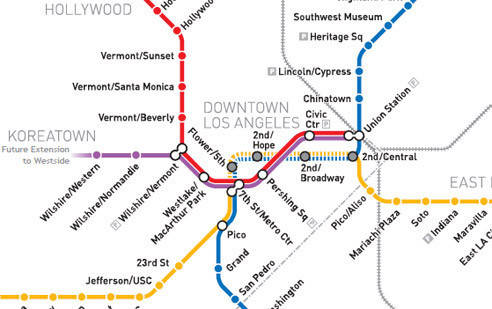
A system map with the Regional Connector in place shows the new Downtown stations that the project would create.

A project designed to connect all but one of Metro's light rail lines into a single system looks to be headed underground, but only if the transit agency can find $173 million. That's the gap between currently identified funding sources and the $1.4 billion that just released environmental documents say it would cost to build the 1.9-mile Regional Connector between 7th/Metro and Little Tokyo.

The project hit a major milestone on Thursday with the , a massive document analyzing the benefits and impacts of five different build options.

Metro staff recommend that the agency move forward with the fully-underground build option, a choice only officially added back in February. That's the choice that community members have been calling for since early project meetings two and a half years ago.

New stations would be added at 5th and Flower, 2nd and Hope and 2nd and Broadway, while the Gold Line's existing Little Tokyo / Arts District station would be replaced with a new station underneath 1st and Alameda. The document says that the Financial District station could be eliminated if new funding is not identified.

According to the document, the underground connector would save transit users 20,400 hours of travel time annually by eliminating one to two transfers currently needed to get from the Blue and Gold Lines to points elsewhere on the system.

Currently, all passengers on the Gold and Blue lines must transfer to the Red Line to get to points deeper into Downtown than Union Station or 7th / Metro Center. An additional transfer is required if the passenger's final destination is on a different line. Those transfers increase congestion in those two key stations.

With the Regional Connector in place, one less transfer would be required and that movement could take place at any one of the new stations created by the project.

A pair of stakeholder meetings will be held in September, one on September 28th from 6:30 – 8pm at the Japanese American National Museum, and the other on October 4th from 11:30am - 1pm at the Police Administration Building's Deaton Auditorium.

After a 45-day comment period, Metro's Board of Directors will vote on whether to take the staff recommendation and make the fully-underground option its "locally preferred alternative."

Metro anticipates opening the link in 2019, but that timeline could be sped up if Mayor Antonio Villaraigosa is able to convince the federal government to provide funding for his "30/10 Initiative," which would compress 30 years of transit projects into just one decade.

SHARE:

||

Related Topics


Topic:
Regional Connector

35 stories


Related Stories:


Conversation

User_32

Tornadoes28 on September 03, 2010, at 09:30AM – #1

I pray they can get the additional funding. It seems such a waste to spend so much and build this system but not to it's full potential if they eliminate the Financial District station. I have no doubt this station would be very busy.


Guest 1

Guest on September 03, 2010, at 10:23AM – #2

You mean they might eliminate the Financial District Station at 5th and Flower? So people would have to walk an additional two blocks to 7th and Flower? Or up to 2nd and Hope? How dare they ask Angeleno's to walk two whole blocks? That is completely unreasonable. We are not used to walking.. - perhaps we could get in our cars and drive the additional two blocks?.. - it would be more convenient that way. Asking us to walk an additional two blocks might lead to heart attacks, heat exhaustion in the summer, and definitely additional perspiration. That would lead to significant legal liability, (and smellier people next to you on the train - thats just unnatural!)

And what about the people at 6th and Flower! Why is there not a stop proposed at this corner as well? Guests from the Standard hotel would not be being treated fairly as they would have to walk a block in either direction! This is blatant discrimination against hipsters! Hipsters everywhere should rise up and protest - fight for hipster rights!

Also, eliminating the 5th and flower stop would slightly reduce travel times of every single person aboard these lines. This is also unfair. We are accustomed to traffic jams and very long travel times, not fast efficient subways that completely bypass traffic. At least add more stops to slow it down. If we do not, it would bring untold numbers of Angelenos home just a little faster, forcing us to spend a wee bit more time with unpleasant significant others, and our unruly offspring.

I mean who proposed eliminating this vital station? It is just so key - so vital to the entire system.


Chris Loos on September 03, 2010, at 10:24AM – #3

Pretty cool to actually see this thing on a map. So the gold line will always be Santa Monica to East LA, and the blue line will always be Long Beach to Pasadena? Or will they have every other train switch?


Eric Richardson () on September 03, 2010, at 10:31AM – #4

Guest: While I'm all for promoting walking, in this case I think you've actually got a dense enough neighborhood where stations several blocks apart might well make sense. It would also lessen congestion pressures on an overloaded 7th / Metro station.


User_32

Jim Shafer on September 03, 2010, at 11:10AM – #5

Excellent news! Congratulations to the Little Tokyo Community for pressuring the MTA to officially consider the all-underground option. Let's hope the board of directors will agree with their staff in 45 days.


Guest 2

Guest on September 03, 2010, at 11:24AM – #6

So basically if I read this correctly, this will allow the blue, gold, and expo lines to inter-operate trains, but passengers would still be required to switch between blue/gold/expo and red/purple at Union Station or 7th St. Metro Center?

Also sounds like if they run trains in all possible combinations, you'd only have maybe one-two trains per hour to each possible destination if they continue running trains ever 12 minutes, as each train would (I think) have 3 possible destinations.

i.e. Expo line in Culver City heading east could conceivably go to Pasadena or East LA via the existing Gold Line route, or to Long Beach on the blue line route.

Or Gold line in Pasadena could continue on to east LA, head to Culver City on the expo line track, or down to Long Beach on the Blue Line track.

Must admit, sounds good!

Also, anyone know if they've made any sort of decision about Purple Line extension (to UCLA, VA, Santa Monica, possible station locations?), or possible extension of the Red Line from Hollywood / Highland west through West Hollywood then south to reconnect with the Purple Line extension?


Guest 1

Guest on September 03, 2010, at 12:13PM – #7

Eric: I agree with you: "stations several blocks apart might well make sense". several(a): (used with count nouns) of an indefinite number more than 2 or 3 but not many; 7th & Flower is 2 blocks from 5th & Flower. (Wilshire comes in at half a block if you look at the map) 2nd & Hope is several blocks away. Who knows,.. it might even bring some bankers, lawyers, and accountants into a bit of culture: Disney Hall, Colburn, and the Broad Museum. It is much more important that this just gets built, all underground thank goodness. Whatever funds would be saved by not building this station could be used for the subway to the sea line - so that this "just gets built" too.


Guest 3

Guest on September 03, 2010, at 01:25PM – #8

Just to clarify, there will trains running from Pasadena to Long Beach always with no transfers. Additionally, there will be trains running from Santa Monica to East LA with no transfer.

There will be no spurs or branches that would allow non-stop travel, say, from Santa Monica to Long Beach.

However, at each of these new stops you would be able to board either the Pas-LBC line or the SM-East LA line.

My thought: a Flower and 5th Street station seems like money that could be better spent elsewhere, and the additional stop will only slow down people traveling through Downtown.


Brigham Yen on September 03, 2010, at 01:46PM – #9

Guest: I think the 5th/Flower stop would be beneficial. The goal is to make Downtown LA the undisputed center of walking in the region. The goal is NOT to funnel people as fast as possible THROUGH downtown LA, but to make it as convenient as possible, and since 5th/Flower is such a prominent corner, it would make perfect sense to put a stop there.

We can't continue to think like we did in the past with trying to get people in and out of Downtown LA as fast as possible.

Plus, the fact that Manhattan is ALL about walking, and for that city to have subway stops so frequently scattered throughout the island, means people have convenient access to stations almost everywhere. Hence, why they are now starting construction on the 2nd Ave subway.

I say find the money to put a station at 5th/Flower. Do it right Metro!


User_32

Rich Alossi on September 03, 2010, at 02:11PM – #10

I live at 6th and Flower, and while I appreciate Guest #2's humor, I have to agree with others that 5th and Flower is a pretty important stop. Right now, 7th/Metro serves everything from Staples at 11th Street, up to 3rd/Grand, and is the only station in the foreseeable future that will serve the southern Financial District/northern South Park. I'd say it's even more important than the 2nd/Hope station.

Brigham is correct. It's not about funneling people from Eastside to Westside as fast as possible.

Also, hipsters don't go to the Standard. That seems to have become a catch-all term for anyone under 30...


Guest 1

Guest on September 03, 2010, at 02:18PM – #11

Eric, Brigham Yen: Of course you have good points, - I dont think it would be that bad to put it there, I was more arguing the other POV in order to suggest that its not that bad if it is eliminated. Both sides have valid points I believe, so either way it goes, Im certainly OK with it. Its importance, however, pales in comparison to the importance of completing this all underground, and completing the subway to the sea (not just to UCLA < I mean really??). The overall transit solution must be always kept in mind, as focus one singular aspect without the big picture in mind has in the past led to short sighted solutions.


Eric Richardson () on September 03, 2010, at 02:53PM – #12

Metro has said that their plan would be to run two basic lines at first: a north-south route from Long Beach to Pasadena and an east-west one from Culver City to East L.A. Transfers could take place at any of the shared Downtown stations.

Once the tracks are connected, though, you do open up the possibility of running services to a variety of destinations.


User_32

on September 03, 2010, at 03:47PM – #13

Considering how strongly that the Little Tokyo neighborhood fought for this, shouldn't the subway station at Second and Central be called "Little Tokyo?"

After all, the station will be right in the middle of Little Tokyo, and the existing Little Tokyo station won't survive the construction.

Little Tokyo deserves a replacement station.


Guest 2

Guest on September 03, 2010, at 04:12PM – #14

So, just out of curiosity, if the funding was there today and all of the bureaucratic and legal nonsense could be eliminated, how long (from an engineering / construction perspective) would this actually take to build?


Brigham Yen on September 03, 2010, at 04:48PM – #15

James Fujita - I would lobby to get that on Metro's radar screen if you haven't done so already. I think it SHOULD be called Little Tokyo instead of just 2nd/Central. I mean, Chinatown got a whole station named after it, and I think LT would be appropriate as well for 2nd/Central.

The reason why Koreatown doesn't get any stations named after it is because there are actually THREE stations within Koreatown!


Guest 4

Guest on September 03, 2010, at 06:20PM – #16

The 5th and Flower station is VERY important. The idea is to get a lot of office workers to work without having to transfer to the red line. It's not just two blocks we're talking about. Many of the offices are north of 5th. When you add in the transfer time for the red line and a 3-4 block walk, a commuter could lose 20 minutes in each direction. There is a lot of bang for the buck here. Also, the additional time at the station would be minimal. And as for naming the stations after ethnicities. This is insulting. Demographics change. Metro should find station names that help people navigate.


Guest 5

Guest on September 03, 2010, at 06:27PM – #17

$1.4 billion for 1.9 miles. My stars, that is a lot of money! Since nobody else seems to think that amount is a problem, I have a question for everyone.

How much would you consider to be too much? Let me know what number, if any, would cause you to drop your support for the Regional Connector.


Guest 6

Guest on September 03, 2010, at 07:45PM – #18

Regarding the 5th & Flower Station: As a mid-city resident, I find it outrageous that Metro is considering building a station only TWO BLOCKS from an already existing station. But on the purple line, they plan on running TWO MILES from Western to La Brea without a stop.

With money being the issue, they should build the Crenshaw station before they even consider building 5th & Flower.


User_32

Russell Brown on September 03, 2010, at 08:18PM – #19

Although there are many comments here about station location desirability, that process occurred for the last 2-3 years ago. It is called community outreach and scoping meetings. Both Westside Extension and Regional Connector have held over 30 meetings over the years.

Many alternative routes and stations locations are discussed. The community weighs in with its preferences. Then Metro and others analyze the options, costs and ridership numbers. Geological testing occurs to analyze construction obstacles and to help predict costs. Then cost effectiveness models are created.

By the time the local preferred alternative is presented, almost 3-5 years of work has been accomplished.

A Crenshaw Red Line station is an example where the community is split in its support, with many vocal opponents. It is a low density residential and commercial area. There is no support for further development. That station does not connect with many other bus lines, and the majority of riders were shown to pick up the line at Western or Fairfax. However, the distance between stations is longer than ideal. No consensus, no strong ridership numbers- probably no station.

The under-grounding of the Regional Connector is also a very good example of how the community can design transit systems by being engaged. The proposed local alternative is far far superior than all of the proposals that started for considerations. Something like 34 options were considered.

Metro thought that they could only support and finance an all surface option. Imaging the Washington Blvd, Blue Line through the 2nd street tunnel headed east and splitting Little Tokyo in half. All vehicle traffic on 2nd would have been lost. That was Metro's initial preferred route. Community engagement that was smart and involved non-stop changed that.

A large amount of info is posted at Metro’s website and it is easy to follow past conversations and decision making by searching transit blogs and blogdowntown articles and comments. http://www.metro.net/projects/toc/


User_32

Russell Brown on September 03, 2010, at 09:48PM – #20

From Metro announcement:

Because the Regional Connector offers a one-seat ride through downtown, ridership on all the light rail lines is expected to increase as commuting times decrease and transit becomes more competitive with driving. For example, the Gold Line is expected to see a 10% ridership gain between Chinatown and Pasadena and an 18.4% increase between Little Tokyo and East L.A.

•About 90,000 passengers are expected to ride the Regional Connector on the average weekday, including 17,000 who do not currently use mass transit. At present, the Blue Line is the most heavily-ridden of Metro’s light rail lines with 77,545 average boardings each weekday.

•The Regional Connector is expected to save many passengers 10 to 20 minutes in the time it currently takes to transfer to another line. For example, a passenger on the Blue Line will no longer have to transfer at 7th/Metro Center to the Red Line to reach the Civic Center in downtown L.A. And a passenger on the Gold Line will no longer have to transfer to the subway or a bus at Union Station to reach downtown L.A.’s central business district.

•Downtown L.A. remains the LARGEST employment center in the county and the Regional Connector will pass through several parts of downtown expected to keep growing in population and jobs in future years.


Brigham Yen on September 03, 2010, at 11:06PM – #21

Thank you Russell for your in-depth response and it's so refreshing to read so many people are finally starting to get what mass transit is about.

The Downtown Connector is ONE OF the most important rail lines LA can build at this time. And $1.4 billion is absolutely worth it for the positive change it will make to the city dynamics that will alter the entire inertia of a city run amok with sprawl hell.

LA needs to invest as much as necessary to bring back the central core and start reversing the egregiously detrimental effects of urban sprawl. Imagine the amount of money wasted in productivity and gas while millions sit in traffic, which happens EVERY DAY. Yes, $1.4 billion is worth it.


User_32

LAofAnaheim on September 03, 2010, at 11:53PM – #22

A lot of the guests here apparently cannot count. It's not 2 blocks between 5th and 7th street on Flower...it's 3 blocks. Everybody forget about Wilshire blvd? A 5th/Flower station is very important as it gets people from the Expo/Blue/Gold lines closer to Pershing Square area without having to transfer to the Red or Purple Lines. There will be more people boarding this station than Crenshaw station will ever see. Like Eric said, more stations make sense for downtown, but not for mid-city and other parts. The density is here, and with more stations, we can see even more density in the right place, which is downtown LA.

As for station namings, I would say we need to also re-adjust the station names of 5th/Flower to Financial District; 2nd/Hope to Bunker Hill; and 2nd/Broadway to either Broadway or Old Bank District (this will be the closest a station will ever be to the Old Bank District).

For the guest who said naming stations is insulting.....why do we have Chinatown and the existing Little Tokyo stations? Same with other cities worldwide...?


Guest 7

Guest on September 04, 2010, at 12:58AM – #23

Isn't the Pershing Square station just a couple of blocks from the OBD?


Guest 1

Guest on September 04, 2010, at 01:01AM – #24

Russell Brown: Thanks for the info, especially on how to get more involved. I hope many more do. But certainly not all will be able to or choose to. I think for those people, being able express themselves and their opinions here is a good thing and it should be encouraged. To suggest that they are late to the game sounds elitist, arrogant, and out of touch.


User_32

Russell Brown on September 04, 2010, at 01:05AM – #25

Just a reminder that the standard north/south blocks downtown are twice as long as the east west blocks. 600 feet versus 300 feet.

So 3 north/south blocks is the same as 6 east/west blocks.

A look at the NY subway map shows stations on the 1 Line Broadway/ 7th Avenue at 18th, 23rd, 28th, 34th, 42nd, 50th, 59th, 66nd, 72nd, 79th etc. So it is not uncommon in dense central city neighborhoods to have stations close together.

I can call Metro and ask the ridership number increase for the 5th & Flower station. It would not have been left in the local preferred analysis unless the numbers were there.

Maybe someone from Metro or the Roberts Group is following and can help with the stats?

If you want to be real critical, the Gold Line foothill extension numbers are not as impressive as the Regional Connector results. However, both geographic equity and the opportunity to now work with SG Valley cities that are united and enthusiastic in redesigning their cities and priorities around transit oriented density is a huge turnaround from even 10 years ago.

Remember, there is no subway to the sea already built because Hancock Park and the westside cities and communities fought in it the early 1990's. They now are unanimously in support and even pushing for an additional line from Hollywood & Highland through West Hollywood to connect up with the Red Line at LaCienega. This may also be where the Crenshaw line hooks up north and south.

We have made huge progress in just the last 3 years in changing the future face of transportation in LA County and the state. The high speed train and the future downtown streetcar will add even more interconnectedness.

The entire 3 miles of streetcar from Disney through Broadway to LA LIVE Convention Center is a little more than half the cost of one Regional Connector/ subway station.


Brigham Yen on September 04, 2010, at 01:47AM – #26

Russell Brown - Yes, that's exactly what I posted earlier as well that Manhattan, which is truly a walking city, proves that the more subway lines you have in a dense built environment, the more conducive it becomes for walking.

The fact that Manhattan is only 2 miles wide at its widest, with several lines going through it and a new subway line under construction (costing billions upon billions of dollars) under 2nd Ave means that you can never have enough stations in a densely built environment.

For the 5th/Flower station, it is absolutely necessary to include it to give Downtown LA as much access to rail as possible because it is the most densely built environment in all of Southern California (even more than Downtown San Diego). Downtown LA is a unique place.


Guest 8

Guest on September 04, 2010, at 02:49AM – #27

I think most of us would love to have a station on just about every corner, but at some point the cost is too much in today's dollars. If one station has to be dropped, so be it.

Lucky for Manhattan, the lines and stations were built long ago when labor, construction, and land costs were tremendously lower than today.


User_32

on September 04, 2010, at 07:00AM – #28

These connectors are so important along with adding of street cars. It would create less travel time and more efficiency in the metro system.

Cheers,

John Apodaca www.daddyosmartinis.com


User_32

Nancy Richardson () on September 04, 2010, at 08:32AM – #29

Yesteday, I came in from Pasadena around 5:30.....and got on the Redline at Union Station, and by the time I got off at my stop at 7th/Metro Center, the train was packed like a sardine can.

Who is that right wing urban planning guy at Chapman College who says that the only people who use public transportation are maids?

Over at Huffington Post there was a topic on LA Public Transportation which took into account the current planning, and there is still this mindset that LA has crappy PT. As someone who uses PT for the majority of my travel, I know for a fact that I can get to Encino by subway and Express bus faster than driving, but people my age still look at me like I am two steps away from homelessness because I travel by PT. I also sent my kid to Public School, so that is the kind of attitude you get from people who consider themselves liberals. (he is now in Australia getting his masters in Urban Planning)

In any case, I find this plan terrific, and remember back to the late eighties when my husband was working for Metro rail that the initial planning. We thought it would never happen...

and now it is fantastic and just getting better.

In these times of horrible bad news....this is one bright spot we can't let get away from us.


User_32

Nancy Richardson () on September 04, 2010, at 09:17AM – #30

Oh yeah, that "rightwinger" I mentioned before...

it is Joel Kotkin.

Here is what he has to say the MTA rail projects:

http://www.joelkotkin.com/content/00273-mass-transit-great-train-robbery


Guest 9

Guest on September 04, 2010, at 09:49AM – #31

Come on! If someone has a different (and I agree, wrong) view, that doesn't make him or her a right winger!

Yes, Kotkin has a beef against rail and urbanism, and he thinks the suburbs rule supreme, but he's not a conservative.


User_32

Nancy Richardson () on September 04, 2010, at 09:54AM – #32

You might want to look into who funds his enterprises before you make such assertions.

http://www.calitics.com/diary/12325/joel-kotkins-war-on-california


Guest 9

Guest on September 04, 2010, at 10:42AM – #33

So all of our friends and family who only drive their cars for transportation and prefer the suburbs to Downtown living must be rightwingers, too?

And the Obama presidential campaign was funded by $994,795 from Goldman Sachs, so surely he is in the pocket of Wall Street and only cares about bankers, right?


() on September 04, 2010, at 10:42AM – #34

I have known Joel for many years and while we very much disagree about Downtown, I have a lot of respect for him. He is also a classic example of what used to be called a'liberal Democrat', and he is nothing resembling a right-winger. He has also been a long time supporter of immigration and he has written for decades about LA's immigrant communities and the positive affects that have had on this city.

But he also believes in reporting the facts and the facts do show that mass transit has - so far - not been as effective as has been hoped anywhere in this country. In fact the percentage of trips by cars in LA versus mass transit has until very recently been INCREASING during the time when LA has been building mass transit. The more mass transit we have been building, the lower the percentage of trips in the greater LA area by transit has been.

Now I disagree with Joel on why this is happening and what should be done - but at least he has a factual basis for his arguments. And, hopefully, someday the people I do agree with on this issue will not be afraid to factually discuss why the suburbs have growing far faster than inner cities and why even in New York, only 10% of all trips in the larger region are made by transit. Continuing to ignore these facts only makes it impossible to solve our problems


User_32

Nancy Richardson () on September 04, 2010, at 12:47PM – #35

Golly Brady, speaking of name dropping, my old friend of 40 or so years, Mike Davis was telling me, you just haven't lived until you have been fact-checked and patronized by Brady Westwater.

And by gum, he is right...

Concern trolls like Kotkin, who used to work for the DLC...and is currently to the right of Joe Lieberman and Ben Nelson, is not now and has never been a liberal Democrat (but then again David Horowitz used to claim to be Soviet style Marxist, so one never knows.)The term you might be looking for here is "classic liberal" or "neoliberal" or "liberal hawk," and have more in common with say Bill Kristol than any legit center-left intellectual currently at the think tank feeding trough.

When one is anti-union, pro offshore drilling, and for MORE tax cuts during a horrible recession, that might a clue someone isn't and never was a liberal Democrat.

But as the man says, reasonable people can disagree...


User_32

Russell Brown on September 04, 2010, at 12:52PM – #36

Response to # 24 To suggest that they are late to the game sounds elitist, arrogant, and out of touch.

Not sure how educating folks of the opportunities and time-lines for participation and involvement is elitist.

My comment was that many of these decisions are going through a lengthy public procees. It is open to all. Metro and the community desperately wants smart ideas and an engaged community to participate. That is what builds support and gets these projects built.

My comment was that to not participate and have such a strident opinion after the fact without getting engaged earlier is a little like complaining that airlines do not want your business when you show up an hour late to your flight. Folks are listened to when they participate, otherwise you are left out. Same with voting and all other forms of involvement.

All of this info is online. Without even attending meetings there are weblinks, and broadcasts. Written comment is treated the same as in person verbal appearances. Regional connector is under a 45 day comment period now.

If my comment was misinterpreted, I apologize.

Folks should feel very emboldened that anyone who is informed and participates really does a pretty big say in designing these systems if their intent is to be constructive and work toward solutions.


Guest 10

Guest on September 04, 2010, at 02:40PM – #37

Mike Davis doesn't even like Los Angeles. Well, I'm just basing that on my own dumb assumptions. Bring him here to post so we can get to know the true him. And someone bring Joel K.

At least we know we all here love Downtown Los Angeles. Don't forget that!


Guest 6

Guest on September 04, 2010, at 02:54PM – #38

To Russell Brown:

In support of a station at 5th & Flower, you said: "A look at the NY subway map shows stations on the 1 Line Broadway/ 7th Avenue at 18th, 23rd, 28th, 34th, 42nd, 50th, 59th, 66nd, 72nd, 79th etc. "

I know. I am a former NY'er. Which is why I am dismayed that you don't endorse a Crenshaw station. The L.A. subway will have a TWO MILE gap without a station between Western and La Brea.

There is no neighborhood in New York that the subway goes though YET doesn't stop. Whether in Midtown Manhattan or Jackson Heights, Queens, the subway stops at evenly spaced intervals. And as you indicated, those stops are merely blocks apart. Not miles.

There were little more than 150,000 people living in the entire borough of Queens when the number 7 IRT subway opened in 1915. The IRT company could have spaced the stations much further apart once the subway left Manhattan. But that didn't happen. The stations were still built every few blocks, even in relatively rural Queens. Current population density be damned; They were building for the next 100 years. And so are we.

Oops. But we are not. In Los Angeles, in the middle of the city, we are going to have a TWO MILE gap without a stop. Why?

You know the answer as well as I: "There is no subway to the sea already built because Hancock Park ...fought in it the early 1990's." And today, the reason Crenshaw is only being considered as an optional station is because of the "vocal opponents" who oppose any "further development" in Hancock Park. And since there in no clear consensus, the "vocal opponents" will most likely prevail and the optional Crenshaw station will not get built.

Is that what it all comes down to...the group that speaks out the loudest wins?

I just hoped that someone like you, someone with a knowledge of how a subway can truly bind a city together, would have advocated for a station between La Brea and Western. Despite the "vocal opposition".


Guest 1

Guest on September 04, 2010, at 04:35PM – #39

@Russell Brown#36 Thanks for clarifying. I couldnt agree more with encouraging those with opinions to get involved in ways they really can have an impact: by going to Metro and outreach meetings early on and voicing your opinion there. I guess I was more taken with the tone of opening paragraph:

"Although there are many comments here about station location desirability, that process occurred for the last 2-3 years ago. It is called community outreach and scoping meetings. Both Westside Extension and Regional Connector have held over 30 meetings over the years."

The expression of public opinion takes many forms and blogdowntown, and blogs like it, have in a way opened up the democratic process by giving a greater voice to the community, and I think that is a good thing. Blogdowntown has reported on the downtown connector for years as well, and the comments sections have been full of strident opinions. All of these comments, earlier and later, should be fully encouraged, and even taken into account by astute political leaders. Leaders would be right to give more weight to those who take the time to actually go to meetings and get directly involved, but they should not dismiss other forms of public opinion expression.

If the blogosphere were full of comments mostly one way or the other, and if this public expression had an influence on the location of a station, i think that would be a good thing. If you agree, then i think we are on the same page after all.


User_32

LAofAnaheim on September 04, 2010, at 05:18PM – #40

The problem with Joel Kotkin and his "mass transit studies" is that he doesn't take into the fact that cities become denser when Metro rail is built. Would New York be as built up as it is without the subway? It wouldn't survive. I mean, 7.5 million people a day taking the subway (http://en.wikipedia.org/wiki/List_of_United_States_rapid_transit_systems_by_ridership), how would New York be so dense?

Locally, look at how well downtown, Hollywood, Koreatown, have developed with the Red Line. Drive down Wilshire (yes, drive so you can look up) and count the number of buildings that are here now that weren't there before. The convenience of living in the CITY goes higher when an efficient mass transit system is available. Kotkin ignores this fact.


User_32

Russell Brown on September 04, 2010, at 06:19PM – #41

#38 regarding Crenshaw station.

The concern that you state for the long distance between the Western and Fairfax station has been often discussed. No final decision has been made (I think).

The distance issue (in isolation) would favor a station. However, a station costs almost $200 million. A number of factors become key decision makers. Can significant development occur (is it allowed, is it wanted,is it desirable?), is there a significant increase in ridership (at this point), is there community consensus, support or strong opposition. On this station, it is sort of a draw. In this case NIMBY'ism may win out unless the local community pushes hard for a station.

Often the politics of what is doable and picking your battles means some of the weaker links are left along the battlefield. Not ideal but so goes life.

But the flip side also works if community and political leadership come together for a common goal. The Crenshaw line will be a light rail when it could have been bus rapid transit. The Foothill Extension is fast tracked because the community was organized and demanding so it was moved to the front of the list.

Side Note: The SG Valley leadership is the same community and leaders that fought Measure R non-stop and campaigned against it. There opposition was Measure R was too rail focused with most of the mass transit money going to the Westside (Expo, RedLine, Crenshaw, Green line). They wanted freeway money. Then they were first to demand they get their share when it passed).

I guess you can be born again as a transit conversion.

Measure R was passed by the transit advocates who took the lead and created broader community support. Special thanks to the leadership from Mayor AV.

Someone suggested that you just add a Crenshaw station later. It doesn't work that way. It is build it when you start or it is forever lost. Otherwise, you would have to shut down the entire system for almost a year to add a station. Can not dig a block long 150 foot deep hole on top of existing tunnels with trains and passengers going underneath. (Scenes of Matrix movie appear).

It is late in the game, but I do not think the final decision on Crenshaw has been decided. I have emailed Metro to send me the numbers on Crenshaw, both Century City options and the Westwood / Wilshire versus UCLA/ Village options. Maybe that will help decide.

Anyone know the Crenshaw/ Hancock Park community leadership? Now or never is decision time. (And hope that does not sound elitist.)


on September 04, 2010, at 09:24PM – #42

I love all these comments! (but there is no way i could read them ALL) Brady and Russell you are awesome and Nancy I don't know you, but you're awesome too.


Guest 11

Guest on September 05, 2010, at 12:30AM – #43

I am a huge fan of the Metro Red Line, but I have to wonder how many of the new projects since the line opened in the '90s would have been built without a rail line.

It's sort of a chicken or the egg scenario if you think about it. The subway was planned for the Wilshire route because it was the densest, most traveled corridor in Los Angeles, and the population continued to be on the upswing. Of course (outside of science fiction) there no way to know for sure, but I suspect many developments would have happened even if the subway had never been built. Remember Donald Trump wanted to build a monster tower at the Ambassador Hotel site, and a subway line was the last thing on his mind.

Does anyone know of any research showing how much true economic impact we can specifically give to the Red Line?


Guest 11

Guest on September 05, 2010, at 12:32AM – #44

Last sentence... Does anyone know of any research showing how much economic impact and development impact we can specifically credit the Red Line for?


User_32

Roger Christensen on September 07, 2010, at 12:59PM – #45

Another reason for supporting the 5th and Flower station: the 7th/Metro station is fearfully overcrowded at peak times and is only going to get worse with future rail expansion. The 5th Street station will relieve much of this.


User_32

Russell Brown on September 08, 2010, at 11:00AM – #46

Regarding the need for the 5th & Flower station:

Remember, we are designing a system for the next 100 years. If a station is not included, it cannot be added later.

As Metro was presenting plans for the Harbor subdivision (South Bay to Union Station), future capacity at 7th & Metro was at capacity with the full build-out of the Expo Line, Regional Connector and extensions of the Gold Line both through East LA and Foothill Extension.

There will need to be another route to get increased traffic from LAX, South Bay into downtown at Union Station. These options could include Blue Line Light rail along the LA River/ Arts District or an Alameda corridor route.

The 5th & Flower station will be needed as an expansion for loading and unloading light rail passengers separate from those who need to transfer between heavy rail and light rail. This station can also be another point of connection to the nearby streetcar at 5th and Grand.

http://www.lastreetcar.org/wp-content/uploads/2009/07/LASI_2010-04-23_rev.006.pdf


Guest 12

Guest on September 08, 2010, at 11:08AM – #47

If they don't have the funds and have to drop a station, I hope MTA can at least lay the groundwork for future expansion stations. To me, that just makes sense to make it cheaper and easier to build the 5th/Flower station when they do have the funds down the line.

paul


User_32

Russell Brown on September 08, 2010, at 11:28AM – #48

Regarding adding a station later, according to Metro, that is not an option.

It must be built with the original construction, or not at all. That has also been discussed in regards to the Crenshaw station on the Red Line extension.

The efficiency numbers of costs versus ridership are fine for the 5th & Flower station. The Feds usually pick up 50% of the construction tab through the New Starts program. The balance of the funding is local or non-fed. Measure R pays for part of this. The balance must be funded through an assortment of other sources.


User_32

Jerard Wright on September 17, 2010, at 01:16PM – #49

If I had to make the choice of eliminating a station if the extra funding doesn't come on-line in time I'd argue to eliminate the 2nd/Broadway station and use the Broadway streetcar to connect to the Bunker Hill station to feed the Broadway corridor. The current streetcar could potentially tie to the Pico station to the South and will need a northern tie in at Bunker Hill as its currently considering.

The ridership at 5th and Flower is much too great and it's demand as a means of relieving capacity to the 7th Street Metro Center much too important to eliminate.


User_32

Russell Brown on September 17, 2010, at 05:48PM – #50

The purpose of the Regional Connector is to stop the need for transfers, not to add to them.

The 2nd and Broadway station will connect to Civic Center, Historic Broadway corridor, Million Dollar Theatre, Grand Central Market, Angels Flight, Grand Avenue Project, Civic Center Park. It will be the closest station to Gallery Row and Old Bank District and Historic Downtown.

2nd & Broadway includes connections to the streetcar, Broadway buses, Civic Center shuttles, DASH, and Civic Center Red Line station.

Build it right, don't build it on the cheap. The CEI numbers are amazing. Better than almost every other light rail station in the whole county.

Downtown more than any place in all of southern California can easily accommodate another 50,000 residents and another 150,000 daily visitors. Presently numbers are at 450,000 daily.

Why debate doing this on the cheap and leaving whole neighborhoods disconnected? Think more in terms of what do we want for the future, not where we are today.


Add Your Voice


In an effort to prevent spam, blogdowntown commenting requires that Javascript be enabled. Please check your browser settings and try again.


blogdowntown Photo Pool

Photos of Downtown contributed by readers like you.

Downtown Blogs


Downtown Sites


Elsewhere