blogdowntown
Not currently logged in. [Login or Create an Account]

Stay Connected


Metro Planner Says Regional Connector Budget Has 'Little Margin,' Defends Scaled-Back Designs

By Eric Richardson
Published: Wednesday, October 05, 2011, at 05:00PM
Regional Connector - 2nd/Hope Metro

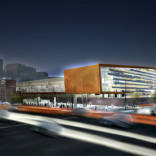
This new rendering of the Regional Connector's 2nd/Hope station shows only one entrance, at the uphill end of the sloping station site. A portal at 2nd and Flower is removed.


$1.4 billion just doesn't stretch all that far these days.

In response to blogdowntown's inquiries about Councilman Jose Huizar's concerns over the potential loss of entrance portals from two Regional Connector stations, a top Metro planner today acknowledged that the Regional Connector's budget is tight.

"This is a project that has very little margin," explained Diego Cardoso, Executive Officer with Metro. "We've got to balance costs. Where do you provide the best balance and keep and maintain the function of the system."

The Regional Connector is working with a budget of $1.366 billion, a number that was submitted to the federal government late last year. As the project planning has moved forward, more of that money has shifted to the Little Tokyo / Arts District station, which was originally proposed as an above-ground station, but now is planned to be constructed completely underground.

"The station at Little Tokyo / Arts District is a key station in the system, because that's where riders that are going to transfer," said Cardoso. "That station is like a 7th and Flower. That's why you need to have a more intensive planning of infrastructure there."

Cardoso defended the additional outreach that has been put into the Little Tokyo station, saying that the numerous small businesses and residents made the neighborhood "a lot more sensitive" than the one around the towers on Bunker Hill.

The Regional Connector's lack of a handy political soundbite may have also left it in the shadows when it comes to issues like a budget squeeze. The project "hasn't really had a political champion," Cardoso said.

He declined to provide any numbers for what the one-portal versions of the 2nd/Hope and 2nd/Broadway stations would save, but said that planners were "conscious about not precluding the ability to do things in the future." For the 2nd/Hope station, that includes adding a "knockout panel" that could allow the second station entrance to be added in later.

Also not part of any current project plans are the additional portals for the 7th / Metro station that were offered up as a possibility when the planned 5th/Flower station was cut over costs. Cardoso said that the agency is beginning a study of 7th/Metro improvements, but that it would be unfair for the extra work to be tied to the Regional Connector budget when multiple Metro projects will be contributing to increased traffic at the station.

"If Regional Connector is going to have to pay for all of the improvements that need to be made, we will not be able to build Regional Connector," he said.

That isn't a sufficient answer for Councilwoman Jan Perry, who in October called on Metro to continue study of the 5th/Flower station and to not pit one Downtown neighborhood against another.

"I'm extremely concerned," Perry said this evening. "We went through public hearings and built people's confidence in the project."

"I think that the commitments that have been made to the community after enormous debate and discussion should be honored."

Perry said that no one from Metro has reached out to her about the proposed changes, and that she has had to go in search of the information.

Planners need to finish the project's final environmental documents this month to have them in front of the Metro board in December. They then hope to get a Record of Decision from the Federal Transit Administration in January, and a funding agreement soon after that.

Only then will station design issues be brought back to public meetings.

"As soon as we get the green light from the federal government, we go back to the community," said Cardoso.


Update (6pm): Shortly after our story posted, Metro .

The agency downplays the changes, saying that "This type of value engineering typically occurs in the preliminary engineering phase of a construction project to bring costs in line."

_Update (6:35pm):__ Added quotes above from Councilwoman Jan Perry, who had criticized balancing the budget at the expense of other parts of the project back in October when the project went to Metro's board.

SHARE:

||

Related Stories:


Conversation

User_32

Steve White () on October 05, 2011, at 05:12PM – #1

When he says the Little Tokyo Station is where riders will transfer, what transfers is he talking about?

All of the stations between Pico and Little Tokyo will be shared for these lines, so technically they can all be used for Expo/Blue/Gold (or whatever they change them to) transfers.

I haven't actually seen any of the designs for the Little Tokyo Station... will it be designed as a major transfer point for busses or other transit options?


Eric Richardson () on October 05, 2011, at 05:23PM – #2

The design for the station has actually been about minimizing the land that Metro needs to take in Little Tokyo, so there's not anything like a bus plaza. That wouldn't make sense one stop out from Union Station anyway.

For riders going to/from East L.A. and Pasadena, the station would be their first transfer point, though certainly not the only one they could use.


User_32

Steve White () on October 05, 2011, at 05:32PM – #3

Ok that's what I thought... Do you think that three portals on that station are necessary when the Financial District is now being stuck without any reasonable connection? They lost the station at 5th/Flower, a new portal for 7th / Metro, and now the 3rd/Flower portal.

I think the Broadway station could be ok with this change if necessary -- over at The Source, they did note how short that block between the two portals would have been. I'd just like to see a nice little plaza to connect it to the future streetcar on the Broadway side... and some sort of improvements (whether development or just a pedestrian plaza) for people coming from the Spring St. side.


Eric Richardson () on October 05, 2011, at 06:22PM – #4

Personally, I think the lower portal for Bunker Hill seems a pretty integral part of that site, though you could make a case that the buildings right there already pull all life up from the street. For Broadway, I think it's less about the physical distance than it is the visibility. I thought the diagonal design was nice, and I'm not sure what would go on the site if Metro reduces its footprint.


User_32

on October 06, 2011, at 01:56AM – #5

I'm glad to see that Little Tokyo will still have two portals, because I think portals are extremely important to a subway system. Subway entrances are the only really visible part of any underground Metro. The more portals the system can have, the better.

Little Tokyo deserves two portals. The First/ Central portal location makes sense, and I would hope that any future development at Mangrove would include a new entrance.

That said, we obviously haven't been putting enough money into rail transit if the Bunker Hill station doesn't also get at least two portals.

This shouldn't be an either/or. All of the downtown stations ought to have multiple entrances, and new developments ought to link directly to stations.

Knock out the "knock-out panels" as soon as possible.


Joel Covarrubias on October 06, 2011, at 08:34AM – #6

Two major issues here. Please excuse the extended rant.

The first issue, obviously, is the loss of key entrances to these stations - especially Bunker Hill station. Yes, the primary function of the connector is to connect the rail lines together. But the secondary function was to provide greater access to the rail system to underserved areas of Downtown, like the area west/northwest of the Central Library.

Now, this secondary function is being quickly whittled away. And for what? Seriously, what is the incremental cost for the critical portal at 3rd/Hope? $2 million? $5 million? Enough to make or break a $1.4 billion project?

Keep in mind, this portal/passageway would be nearly level, due to the slope of the hill. AND, it would be far cheaper to build this while the ground is ripped open for the cut-and-cover tunnel.

The second issue is the lack of transparency into the process of "value engineering". Of course, value engineering is a necessary part of project management, especially when your budget is fixed. But when you're going to remove essential elements of a project during value engineering, you should tell the stakeholders (i.e., the public) so that they know what's going on. You shouldn't sneak around in the dark of night with a machete, slashing away at anything with a cost line item that looks (to staff engineers) like it's unnecessary.

Hopefully Metro is also downward-adjusting the ridership numbers they are reporting to the FTA. Because to be fair, this is going to negatively impact ridership, and thus the cost-effectiveness of the line.


User_32

Steve White () on October 06, 2011, at 09:44AM – #7

Joel, I completely agree that this will affect ridership.

Especially for the business folks in the Financial District. Just like we're seeing with the discussion over the Century City subway stop, even relatively short distances matter here in LA.

While those who are accustomed to riding Metro are usually also used to walking around the city, those in LA who don't already ride Metro are usually not much for walking. To get people out of their cars we need to make it as convenient as possible (at least at this nascent stage, but really always) for them to get into and out of the station.

Interesting side note, I've found that many people discount the distance they walk when already in a station -- someone may walk a block from a portal in an underground tunnel to the train platform more likely than they would an extra block above ground to get to another portal.


Eric Richardson () on October 06, 2011, at 09:59AM – #8

Steve: It's interesting -- early in this project, I distinctly remember Metro planners making that same pitch in terms of people judging station distance by the entrance, regardless of how far they then walk. One station can feel close to a lot of places with multiple entrances.


Add Your Voice


In an effort to prevent spam, blogdowntown commenting requires that Javascript be enabled. Please check your browser settings and try again.


blogdowntown Photo Pool

Photos of Downtown contributed by readers like you.

Downtown Blogs


Downtown Sites


Elsewhere