blogdowntown
Not currently logged in. [Login or Create an Account]

Stay Connected


An Idea Worth Bringing Back: The Hope Street Promenade
By Eric Richardson
Published: Tuesday, September 25, 2007, at 09:10AM
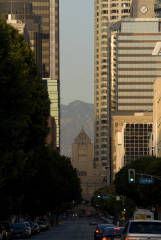
Central Library and Hope Street Eric Richardson []

Running through old articles and documents about Downtown you often happen across crazy schemes for radical ways Downtown should be altered. One of my favorite was the decades long push to take all sidewalks off the ground floor and onto elevated pedestrian ways. In a case like that I'm glad it didn't come through. Often, though, there are some good ideas in the bunch.

This morning some reading brought me upon the Hope Street Promenade, a plan originated in the 1980s to narrow Hope street's traffic lanes and create a pedestrian linkage from the library down into South Park. Landscape architect Lawrence Halprin was to design the CRA-funded project, which would have created a roughly half-mile long park.

In a memo the CRA described the plan as:

a pedestrian link from Olympic Boulevard on the south to the Los Angeles Central Public Library on the north. The Hope Street Promenade will be a pedestrian-oriented linear park along Hope Street which will feature 30-foot wide sidewalks with landscaping and new trees.

The Promenade is even found in the , last updated in 2003.

Given the new life Ralphs has given to the area around 9th and Hope, the Hope Street Promenade seems an idea definitely worth bringing off the shelf and into actual thinking. Given that it's not a through street in either direction, Hope certainly has that quiet pedestrian character to it already.

In other park'ish news: Our contest asking where you would put play space Downtown (and part two) ended yesterday and I just did the drawing to see who won shoes. We're contacting the winners and then will be announcing them here soon.


SHARE:

||


Conversation

Guest 1

John Crandell on September 25, 2007, at 02:32PM – #1

THE L.A. MILLENNIUM PROJECT COMPETITION PROGRAM (1992)

INTRODUCTION

The area for the competition was conceived in the 1970’s as the setting for a future urban village consisting of a mixture of residential, service, entertainment and business activities. In the course of sixteen years of redevelopment in South Park, the local redevelopment agency has guided and assisted in the implementation of new office, retail, residential, transit and open space developments as well as the present expansion of the city convention center. The agency is now faced with extraordinary budgetary constraints and simply cannot entertain the task of implementing additional open space as a means of stimulating private investments. The quality of any addition to the Grand Hope Park and Hope Street Promenade open space elements must be sufficient enough to attract private funding. The basic thesis for the competition is that a creative re-examination of the design potential held by the Hope Street Axis in South Park could very well result in a number of spectacular solutions, any of which might then warrant the needed funding from private sources.  
The site as it now exists consists of approximately four city blocks which will be formed into a single planning unit bordered by Eleventh Street on the north, Grand Avenue on the east, Cameron Lane on the south and Flower Street on the west. Hope and Twelfth Streets within the site can either be maintained or be abandoned (with sufficient justification) from automotive use at the discretion of competitors. Pico Boulevard will be maintained, but can be realigned for design purposes. The four block compound would become known as ‘Millennium Place’ and a large sculptural object would be known as ‘Millennium Tower’. The unfulfilled potential of the Hope Street visual axis which bisects the site, continues to present an unparalleled urban design opportunity for the city at large. The intent of The L.A. Millennium Project is to provide a full and highly creative investigation of that opportunity.

DESIGN PROBLEM

In this most transient and expansive of all cities, there is the particular lack of one symbolic place which provides resolute identity, either within or to the outside world. A strategic twenty two acre portion of South Park has long been in need of particular design consideration and be so organized as to provide a singular and complementary response to the Central Library tower, Bertram Goodhue’s great terminus to the Hope Street corridor, three-quarters of a mile distant.
The architectural, artistic and urban design conception for these twenty two acres must elicit a lucid and positive response from the entire social spectrum of Los Angeles. One central exterior space, defined by an impressive array of new structures should become recognized the world over for it’s resplendence and timelessness, for the sense of human affinity and joy which it may impart to those who so choose to visit.

DESIGN ELEMENTS

The finest resolution for this project must be a compelling scenario which will entice the imagination of the entire metropolis. This new place for Downtown Los Angeles can serve to mark the city’s ascendance from turmoil and become highly held in the public memory, a vibrant locus for simple pleasure, for learning, and for great civic events; a place which will always serve as an extraordinary emblem of our diversity and our collective aspirations.
  1. A civic monument set on-axis with Hope Street; it’s height not to exceed 300 feet.

  2. An intimate urban square to serve as centerpiece for the four block complex; the primary use of the square would be as a performance venue for musical and other cultural events and be managed and programmed by adjacent property owners. To assure flexibility, the floor of the square would be flat and would not be configured as an amphitheater.

  3. A place of resolution: A quasi-ceremonial chamber room with supporting facilities where meetings would be held for arbitration and resolution of extralegal controversies, between whatever groups or individuals. The chamber and supportive spaces would be contained within a small structure, especially conceived as a sculptural object, located within or adjacent to the square.

  4. A 200 room ‘suite’ hotel.

  5. Midrise apartments (minimum 400 units/maximum 800 units within three or more separate towers).

  6. College extension facility: Downtown accommodations for joint use by area universities.

  7. An indoor entertainment venue for innovative or futures-oriented amusement and edification.

  8. Popular entertainment: cinema, music, dance clubs and dining at ground level surrounding the square.

  9. An industry trade center for digital products and services: to include display/demonstration spaces, instruction facilities, executive meeting rooms and offices for computer related service firms. Also included would be a corporate sponsored automated library within a central hall directly off of the urban square with terminal gardens providing free public access to automated caches of information. This library would feature convenient multilingual databases, high resolution displays/printers and inexpensive printouts.

  10. Various small shops and cafes wherever possible at ground level along with a novel grocery emporium, modeled perhaps in imitation of Broadway’s Grand Central Market or Boston’s Faneuil Hall and Quincy Market.

(adopted the evening of April 29th, 1992 in the office of A.C. Martin & Associates, just as the great riot was breaking out.)

Sam Hall Kaplan, Lita Albuquerque, Susan Whitin, Pamela Miller, Sister Karen Bocalero, Henry Hopkins, John Kaliski, Richard Koshalek, Peter Sellars and Robert Graham all immediately assented to participate as jury members or as honorary members of the board. With help from the office of Congressman Roybal, 501-C-3 tax exempt status for the organization was secured in twenty four hours. A meeting was held in the corporate offices of Transamerica Corporation. A fifty thousand dollar contribution was tendered to the competition effort on the condition that the organiztion gain the approval of the CRA. Right; a cast of preying mantises and hornets then entered the fray. Ironic that at the outset, they mayor had written the protagonists wishing them good luck. Six months hence, all funds which were contributed to the effort were returned (with thanks) to those who had generously donated.


Guest 2

Jordan on September 25, 2007, at 03:03PM – #2

I agree completely. I live above the new Ralphs at the Market Lofts facing Hope Street. It really does seem like the perfect place for a Promenade. We should start a peition or something. It would add a lot of village charm thats lacking around south park.


Guest 3

Naturallawyer on September 25, 2007, at 03:11PM – #3

Anything that will get rid of that rat farm in the bushes next to the Christian Scientist Church (on Hope across from the Macy's plaza). Ever seen those critters running on the sidewalk? That's one thing we've got that's similar to Manhattan...


Guest 4

Justin on September 25, 2007, at 07:04PM – #4

Can somebody do me a favor and point out which page on the Community Plan talks about the Hope Street Promenade? I must be having a stroke because even though the section is posted in the comments section, I see to miss it every time I read (skim) the Community Plan. Also, are there any other links to plans about the Hope Street Promenade? It seems like a great idea whose time has come since the CRA has recently been making some noises about doing "bigger" projects.


Eric Richardson () on September 25, 2007, at 08:17PM – #5

Justin: What John posted isn't from the plan. It's from his trove of fascinating bits of Downtown history.

The Promenade is mentioned on pages 9 and 61 of the Community Plan PDF, both under the heading of South Park.


Add Your Voice


In an effort to prevent spam, blogdowntown commenting requires that Javascript be enabled. Please check your browser settings and try again.


blogdowntown Photo Pool

Photos of Downtown contributed by readers like you.

Downtown Blogs


Downtown Sites


Elsewhere