
Third Street Tunnel: A Primer
 Eric Richardson
[]
Eric Richardson
[]
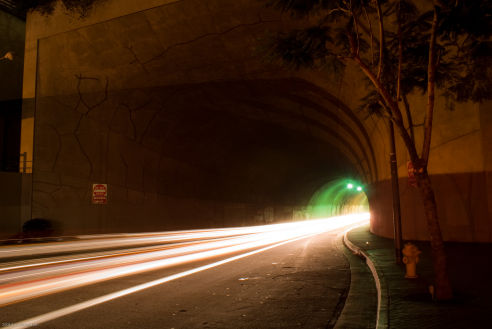
Looking west from the tunnel's mouth, one can see the flat-roofed construction of the Angelus Plaza addition and the beginning of the 1901 tunnel.
DOWNTOWN LOS ANGELES — The elder of the two tunnels under Bunker Hill, the Third Street Tunnel turned 107 years old this year. That makes it nearly half as old as the City of Los Angeles, which this week turned 227.
The 1,240 foot tube's history has been anything but boring. Efforts to get the tunnel approved took a decade, then construction claimed six lives. Once open, the Times called the tunnel a "veritable stench in the nostrils of the public."
That's quite a lot for just one tunnel.
In February of 1889, City Council adopted a motion asking that plans for a Third Street Tunnel be drawn up. They desired to connect those who lived in the Crown Hill neighborhood with the business district located on this side of Bunker Hill. The idea fizzled.
In 1891, Councilman Bonsall again brought up the idea, suggesting that chain gangs could be used to cut down on labor costs.
On July 3, 1893, residents and taxpayers presented a petition to Council asking that the tunnel be created. Their plans called for a tunnel 1080 feet long, with a twenty-six foot roadway and eight foot sidewalks. The City Engineer drew up plans, and estimated the cost at $154,532. Again, nothing happened.
In 1894, Council against asked for tunnel plans. This time cost estimates were brought down to $100,000. Again, nothing happened.
1898 was the year that gears finally started to move. On April 11, Council ordered the City Attorney to draw up an ordinance putting tunnel bonds in front of the public via a special election. That election was held on July 6, 1898, and funds were approved for both the Third street and Broadway tunnels.
On December 29, 1898, contractor C. L. Powell's bid of $88,449 for the Third Street tunnel work was accepted. Construction began in early 1899, but was slowed by faulty equipment and a series of suits between contractors and subcontractors.
Work on the eastern end of the tunnel was easy, but underground water on the western end caused serious problems. Several small accidents occurred in late 1899, sending workers to the hospital after cave-ins sent them tumbling to the ground.
On January 21, 1900, serious disaster struck. Thirteen men were "entombed" in the tunnel dig after a massive cave-in on the western end. Several were killed in the collapse, but others were trapped inside with only the air in the tunnel. Frantic efforts were made to dig into their position. Ten men were rescued, while three perished. Lawsuits from this accident would stretch on for years as the various parties tried to escape responsibility.
On November 25, 1900, the two ends of the tunnel were joined.
Finally, in March of 1901 the tunnel was opened to the public. It was unpaved and unlit.
The Times was not impressed. Consider this paragraph from a story that ran on March 27, 1901:
The new Third-street tunnel is a veritable stench in the nostrils of the public. It is a cesspool of filth, a hotbed of disease. Stagnant pools of malaria-infested mud and water are here, there and everywhere throughout the 350 yards of Cimmerian gloom. Filthy seepage water drips over sidewalk and roadway throughout its entire length. At night its Stygian darkness is unlighted by a single ray, while the periodically-falling plaster from the arch overhead is a constant menace to life.
After many complaints, the tunnel was paved and gutters were installed in 1902. Lighting would take longer to be installed, despite the fact that electric wiring had been installed during tunnel construction.
Within a few years, talk shifted to how busy the tunnel was. A count in September of 1904 recorded 1500 horse teams and 4700 pedestrians traveling through the tunnel in one ten hour period.
The Second Street Tunnel, which opened in 1924, was a belated attempt to reduce the load on the first bore, but a swelling number of cars kept both tunnels fully occupied.
Today's tunnel is a story of sections. In 1968, the tunnel was extended 110 feet to the west as part of Bunker Hill redevelopment. This work added the flared exit that one now sees on the tunnel's Flower street end. In 1981, Angelus Plaza was constructed on the eastern edge of the tunnel, extending it toward Hill street.
The center section of the tunnel was rebuilt in 1983, as part of the construction of California Plaza. The tunnel was closed for eight months, reopening in June of 1984.
The result is a tunnel that has a patchwork quality to it. It's a unique span, a mix of old with various levels of new. It may not get the car commercial love of its newer neighbor to the north, but the Third Street Tunnel is certainly worth a closer look next time you have the chance to pass through.
A multitude of stories from the Los Angeles Times archives were used in preparing this story.







Walmart drew Downtown protests, but why...
Construction begins on $72 million bus...
Construction begins on $72 million bus...
Construction begins on $72 million bus...
Donated collection of maps is like 'Christmas...