blogdowntown
Not currently logged in. [Login or Create an Account]

Stay Connected


Broadway's Upper Floors Targeted With New Reuse Rules
By Eric Richardson
Published: Wednesday, October 22, 2008, at 02:16PM
558 S. Broadway Eric Richardson []

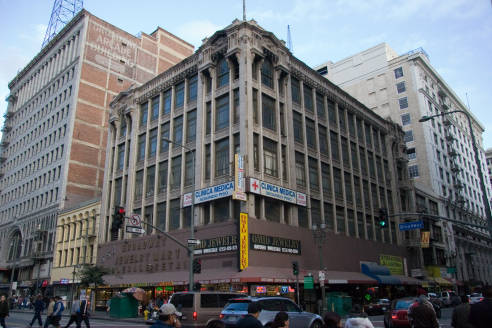
The F.B. Silverwood Building at 6th and Broadway opened in 1920 as a six-floor, 115,400 square foot department store. Today it offers ground-floor jewelry retail and minimal upper-floor use.

Councilman Jose Huizar today took aim at the million square feet of vacant upper floors lining Broadway, introducing a motion intended to remove the red tape involved in converting that vacancy into uses such as creative office space.

Huizar wants to see an ordinance that would do for these buildings what the Adaptive Reuse Ordinance did for residential conversions. His motion calls for an inter-departmental task force to be put together to craft such language.

The motion points at the $6-billion in new development sparked by the 1999 passage of the Adaptive Reuse Ordinance, allowing by-right conversion of old commercial structures to residential uses. "While adaptive reuse continues to be a boon to revitalization and helps preserve historic buildings," the motion reads, "not all buildings are suitable or feasible for housing, leaving a great number of other buildings behind -- vacant indefinitely."

Additionally, the motion targets the 15-20% vacancy rate along Broadway, and seeks to bring help to businesses that wish to open up in these historic structures. It asks for "financial and programmatic incentives" to help with the effort.

The motion asks for the creation of a Bringing Back Broadway Commercial Reuse Task Force, bringing together more than a dozen city agencies and departments. The group would be responsible for returning recommendations to council within 60 days.

It also asks that projects on Broadway and in the Historic Core that has applications in the city's system be put into case management, a process designed to help the applicant efficiently navigate the different city departments involved in a project.

Huizar's office will be issuing a press release on the motion shortly. The motion, seconded by Councilwoman Jan Perry, next must go to the Housing & Economic Development and Planning & Land Use Management committees.


Update (6:30pm): Council District 14 just put out a press release about today's motion.

LOS ANGELES (Oct. 22, 2008) – Councilmember José Huizar introduced City legislation today calling for a Bringing Back Broadway Commercial Reuse Task Force to develop recommendations for an ordinance aimed at encouraging and providing incentives for upper- and lower-floor commercial reuse on Broadway and in the Historic Core.

More than 1 million square feet of commercial space is vacant in the upper floors of Broadway’s buildings and the vacancy rate on the ground floor – which has increased since the exodus of commercial businesses and employees to Bunker Hill – is estimated to be at least 15 percent and is on the rise.

“Unless the City does something to encourage the reuse of long-vacant commercial spaces, we’ll be staring up at architectural ghosts all along Broadway,” said Councilmember José Huizar, who is heading the Bringing Back Broadway Initiative, a public/private effort aimed at revitalizing the Historic Broadway Corridor. “Tragically, too many of these beautiful historic high-rise buildings are completely vacant on the upper floors, and the City will continue to miss the opportunity for much-needed long-term revenue from millions of square feet of vacant commercial and retail space.”

Due to their 19th-Century design and functionality, Broadway’s commercial and theatrical buildings have fallen to substandard levels of occupancy safety, especially in the upper floors. Much of that upper floor space cannot be legally occupied today after years – even decades – of vacancy.

The task force will be convened by the City’s Community Redevelopment Agency within 30 days and will include a wide variety of City departments and business leaders. The task force will then report back within 60 days with recommendations, including meaningful financial and program-based incentives for the consideration of a new ordinance.

The City’s 1999 Adaptive Reuse Ordinance, which allows residential units to be built in underutilized commercial buildings, has been an estimated $6 billion boon to development downtown and to the City’s economy, exceeding the combined cost of the Staples Center, Walt Disney Concert Hall, the Cathedral, and LA LIVE, in addition to the projected cost of the Grand Avenue Project.

“Adaptive Reuse has changed the face of downtown and has jump-started revitalization that would otherwise not have been possible in the Historic Core,” Huizar said. “Unfortunately, not all of the wonderful buildings on Broadway are suitable for conversion to housing and the low-hanging fruit for adaptive reuse have been plucked.”

Due to market forces in place when many Broadway buildings were acquired, ground-floor rents continue to be sufficient to cover operational costs for many building owners, leaving little incentive to invest in the costly renovations necessary to legally reuse upper-floor commercial spaces.

At the same time, independent “Mom & Pop” businesses – especially restaurants and other amenity-oriented establishments – are discouraged from occupying vacant lower and ground floor spaces on Broadway due to costs and difficulties related to completing change of use projects within historic high-rise type buildings.

Huizar will call on the task force to move quickly and to think aggressively and creatively about how to capture the significant revenue the City is currently missing by creating commercial reuse incentives in the historic core and promoting business and job growth downtown.

“There are so many options, even for spaces which would not be appropriate for adaptive reuse for housing – we should look at creative office space and boutique hotels to find ways that restaurants and cafes can more easily get into the vacant spaces on Broadway,” Huizar said.

The Bringing Back Broadway initiative intends to revitalize the historic Broadway corridor so that Broadway can once again serve the City of Los Angeles as a thriving entertainment, commercial and retail center. Planned public projects such as new parking facilities, a streetscape plan, the Downtown LA Streetcar and an entertainment-oriented overlay zone will help prevent this historic corridor from falling into further decline.

SHARE:

||

Related Topics


Topic:
Bringing Back Broadway

16 stories


Related Stories:


Conversation

Guest 1

benjamin on October 22, 2008, at 03:05PM – #1

what are the differences between spaces use for "creative office" and "regular office spaces"? can someone define this?


Eric Richardson () on October 22, 2008, at 03:56PM – #2

Creative people tend to like more raw spaces. I don't believe the intent is for any real difference (such as there is for artist-in-residence). That's just the example use that always gets used.


Guest 2

David on October 22, 2008, at 04:45PM – #3

Not to knock Huizar's enthusiasm but the spaces above the ground floor can already be used for creative office space -- you don't have to go to the Planning Department for any sort of approvals UNLESS that space was originally built for garment manufacturing or something similar (but I don't think that is the case for most of these buildings). My understanding is that these spaces don't hold office uses now because there has not been a demand for these office uses until relatively recently. Considering how much Class A office space was built in 80s and how much was vacant for so long, the newer office buildings poached the tenants from these older buildings to try and fill their buildings. So basically the City needs to grow demand for these spaces and the problem will take care of itself.


Guest 2

David on October 22, 2008, at 04:52PM – #4

And another thing that holds back the office uses for these buildings -- there is no parking. If the City wants to help these buildings, build some public parking structures so the office users have some place to park.

I'm not saying building more parking would be the best overall solution for the City but it remove a significant barrier for these spaces to be used again.


Eric Richardson () on October 22, 2008, at 05:23PM – #5

David: The problem is that the city's rules about how a building has to be brought up to code make it impossible or at least infeasible for a building owner to make their building able to be occupied. There's a lot to be done to these buildings, most of which were originally retail uses and not offices.

Aside from allowing by-right residential use, what the Adaptive Reuse Ordinance did so well was streamline the process of how the city considers and approves these sort of projects.


Guest 3

Bert Green on October 22, 2008, at 05:27PM – #6

The idea of such an ordinance would be to relax the rules currently in effect that prevent this space from being used. Parking is one of those things. These buildings do not have parking, and there is really no way to provide it. Adjust the rules so that its legal to have commercial uses without any parking requirements.

Another issue is ADA accessibility, exiting requirements, etc. There has to be allowances made for the grandfathering of this type of space. Some of those rules have to be relaxed due to the existing nature of these buildings.

Broadway is kind of perfect for transit-oriented commercial uses. Los Angeles law does not do that well, and it's great to see Huizar recognizing the need for changing the laws to make it easier to use this space in a sustainable way.


Guest 4

Take the Bus! on October 22, 2008, at 06:42PM – #7

To the poster who recommended that more parking structures be built: Why?

There are loads of MTA bus lines that serve Broadway and Hill as well as the Pershing Sq street Red Line stop.

No need for more parking structures.


Guest 2

David on October 22, 2008, at 07:11PM – #8

Eric: I have renovated a couple of these buildings myself (not on Broadway but in the Historic Core) for commercial use and got construction drawings done for a couple of other adaptive re-use projects (though they were not built) so I am pretty well versed in both options. The only thing you have to bring-up to code is the life-safety requirements like making sure the building is sprinklered. These requirements are not that much of a problem. The only ADA things you have to deal with are those that are "readily achievable" -- in other words, not expensive. You don't have to deal with a strucutral retrofit and you don't have to get new entitlements from Planning. But this is true for all commercial buildings in the City. If the upper floors were built for retail (really?) then office use is already allowed by-right as it is a less-intensive commercial use. Finally, these building owners can already take advantage of the Adaptive Re-Use Ordinance if they really needed it though I don't think they do. Officially, all these Adaptive Re-Use projects are for live/work projects, not residential. Live/work is technically supposed to be 2/3 commercial, 1/3 residential and anyone occupying the space is supposed to have a business license, not that it happens very often. But look at Eastern Columbia -- Johnny Depp has moved his production company into a couple of the units. Isn't that creative office space? So these building owners already have all the tools they need, they just don't realize it and neither does Huizar.

Bert: Parking is not required for these buildings if they were built without parking and most of these were. These building owners are under no legal obligation to provide parking. I manage a building that has zero parking and it has never been an issue with the City. My comment about the City providing parking is a market-driven issue. The reason why my building functions without parking is that there is a parking lot next door where my tenants park. The lack of parking is why thse Broadway buildings don't function as office buildings -- there is no place for the tenants to park nearby. So if the City provided it, you might find that the buildings would be in demand again. Also, ADA is grandfathered with the "readily achievable" standard. Exiting might be an issue because it is a life-safety issue but I have never had a life-safety issue cost me more than $50,000 -- that is not a lot of money to pay to keep people safe. Plus, the Building & Safety Department is fairly flexible with these old buildings -- they understand it is not easy to change things in them and they only really impose those items that keep people from getting harmed. What I have found to be more of an issue is that a lot of these building owners don't maintain their buildings so when it comes time renovate them, they have such a long list of deferred maintenance they can't pay for it. That is not the City's fault but they still complain that the City is "unfair" and rules are "too expensive" to comply with. Frankly, the Historic Core is filled with really incompetent building owners - I think this is a result of the Historic Core being so out of favor for so long that only people with limited experience were buying these buildings. And now we are stuck with them fumbling around not knowing how to renovate buildings and with no capital to do it. Bert -- These are the same owners who keep their ground floor space vacant waiting for their golden ticket tenant who will pay them $5.00 psf.


Guest 5

Chris on October 22, 2008, at 08:00PM – #9

I am glad that someone in the city is trying to move this forward. I hope it is not too late for some of these buildings - I have heard that many of the structures (especially on Broadway) have upper floors that are in really bad shape.


Guest 6

Bert Green on October 22, 2008, at 09:06PM – #10

There is a lot of parking (paid lots) all along Broadway, on Spring, at Pershing Square, etc. To me the parking is a non-issue, there's lots of it, it's just not on site, which for many people is the same as if it did not exist. But they city DOES still deny permits to renovations that do not include parking on site. They tried to do that to my gallery in 2004. I was at first required to provide 90 spots. It took quite a while to get past that.

If we make this all abut parking then Broadway will never revive. It may be true that the market usually demands parking, but the whole appeal of Broadway is its urban character, and the excellent transit in the area should be its best selling point. The people who MUST have have no shortage of other options. Let's not suburbanize Broadway.

I agree that a lot of the owners in the Historic Core are amateurs (at best) or incompetent (at worst). But regardless, they have been unable to attract tenants for their upper floors. The development that has been happening around them is providing hope for Broadway. I do think that better rules for conversion will help, if only by making the properties more attractive for outside investment.


Guest 7

Downtowner on October 22, 2008, at 09:25PM – #11

David - If a building has been unoccupied for a certain number of years, their rights to be occupied under current conditions expire and all the new codes DO apply.

If a building was occupied regularly the whole time from when it was built, then there is no issues and it can stay occupied "grandfathered" in, but a lot of the Broadway buildings have been vacant for a looooong time, and their rights are expired, which means in order to put anything up there, a LOT of renovation and upgrade is needed to meet current codes.

It's a lot of Building Department and Fire Department requirements, plus ADA, and parking, and the obstacles are real. Both the building department and fire department did extensive presentations about this problem of expired occupancies years ago during the adaptive reuse discussions and this included explanations of why parking requirements for today would need to be met even if there weren't any to begin with (which is why they exempted parking for the adaptive reuse projects)

This is NOT just about sprinklers, at least not now under the new building code adopted in 2008. Not event close.

Also, you can see the actual motion here so we all know what we're actually talking about:

Pay attention to the part of the motion about lower floors too - that shouldn't be overlooked, it's a big deal. Huizar is obviously aware that putting in a restaurant where there hasn't been one before is a very special kind of misery, and really expensive to vent all the way up and put in a grease pit, so the "change of use" stuff is not minor in terms of importance.

Building owners who already HAVE restaurants should NEVER let them be conveted to anything else because it's so incredibly hard to open another one up in a different place down here.

Case management just for the historic core is also a good idea. At least somebody's on top of what needs to happen down here. Bought time. Go Huizar Go!


Guest 8

Jerard on October 22, 2008, at 10:10PM – #12

I think David touched on a small nerve that I think will be important to help Broadway. Some of the small details to David's suggestions I disagree on however the need is there to find ways to sell those upper floors.

Despite the gords of transit to Broadway, it's only affecting the ground floor I think that is the basis to have this grow upward. To get on the upper levels we need to locate those existing parking structures and improve wayfinding signage to them as a both short-term as an idea that can implimented quickly. The key to the signage is that motorists aren't causing excess congestion by circling around trying to identify if this lot or this structure is for parking.

To long-term thinking as to how to use the streetcar as a local shuttle for larger more farther out parking/transit facilities so that it is well utilized and Downtown can develop a larger system or even integrate the streetcar with a dedicated Rapid Bus lane so that there's a street organization that everyone can agree on. Regional Rapid buses on the inner/median lanes, streetcar/bikes on the outer/curb lanes.

Another thing that could be looked at in integration of this are improving the ground floor level with more trees and street landscaping so that this follows through organically on its own so that the landlords will want to develop those spaces because it means greater revenue to the business.

The current make shift planters on Broadway have no scale to it's surroundings and what's even more depressing is that the "trees" look like large overgrown very strudy weeds making Broadway feel really cheap and undesirable. There's nothing wrong with a temporary tree/shrub planter, just make it look attractive and fit to the pedestrian and city scale, have plants/flowers/greenery that enhances the environment.


Guest 9

Juanito on October 22, 2008, at 10:43PM – #13

If we could only get David Geffen interested in historic preservation! Broad remains immune to Broadway, despite repeat entreaties.


Guest 10

Benjamin Pezzillo on October 22, 2008, at 11:02PM – #14

I am a firm believer that the Historic Core needs to court video game production companies as commercial tenants.


Guest 6

Bert Green on October 23, 2008, at 12:48AM – #15

Jerard, you are still fixated on parking. Transit is not a way to get to and from your car, it a REPLACEMENT for the need for a car.

I still maintain that if we see this through a suburban mindset, that the car is king, then Broadway will NEVER revive.


Guest 7

Downtowner on October 23, 2008, at 07:24AM – #16

Bert, you're right, eventually we won't need parking garages because people won't be driving. But the fact of the matter today and for the relatively distant future, say ten to fifteen years, is that a lot of people who will be coming downtown, whether that's to work, or to go to one of the theaters once they open again, WILL be driving.

Some will take transit, yes, hopefully a lot more than do now, but unless they live downtown already a lot of them will be driving, especially because if you take transit TO downtown, it's probably not running anymore when you want to go home.

LA has a lot of problems to solve before we can rationally say "no more parking" because people do still drive, like it or not, and the transit system here isn't good enough to pass laws and charge fees to discourage people from driving because the alternative isn't good enough.

LA is a world-class city with a completely insufficient transit system becausepoliticians in the last thirty years were not willing to stand up to the NIMBYs and get sensible systems built where they made sense to be built. That seems to be changing now, luckily.

But we still have the problem of residents who are not willing to pay for the transit services they will continue to whine about not having. (for instance Measure R is VERY important to getting people out of their cars, but it probably won't pass because people would rather complain about not having transit than do something to pay for it)

If the perception is there's no parking, then downtown could be harmed by that at least for the forseeable future.

However, I guess the Last Seats series that's done every year packs people into the theaters every time they do a show, and those people have to be parking someplace I guess. And we are getting a streetcar downtown, so that will help too.


Guest 11

Karin Liljegren on October 23, 2008, at 07:55AM – #17

I also concur with "Downtowner" that there are a lot of extra obstacles specific to the Broadway buildings.

I've been the Architect overseeing 12 ARO projects and they were all incredibly difficult and all had their own varying set of challenges. However, most of the stock of buildings on Broadway are even more dilapidated and more challenging.

The Fire Life Safety issues are much bigger than you might think, especially if putting bar/restaurants on the lower floors. The other huge expense and space sucker upper are the DWP vaults that will be required for almost every building on Broadway. These buildings require an enormous amount of rework - even if it isn't technically a change of use.

I might also add while the ARO was great for conversion to residential - it was most helpful for planning zoning issues. The building and safety requirements, while touted as "relaxing the code", didn't really serve as a significant benefit. And over the last 9 years, the City only required more and more and more things that they didn't require back in the early ARO projects.

A comment on "creative office" - besides being more "raw", I think the idea is also to promote creativity in the way we work - for example sharing a large office with multiple smaller firms or independent workers. Most of the buildings on Broadway have problems with light and ventilation and can't be cut up into a bunch of small offices.

Hopefully this task force will give a new kick start - let's keep the momentum moving - quickly and efficiently and comprehensively.


Guest 12

sebastian on October 23, 2008, at 07:59AM – #18

If we keep a shortage of parking in downtown, and rase the parking fees people will have to take the lightrail or subway into downtown, and they will get use to it. It will become a click in their brain to think if they're going into downtown they got to act like they're in the city and take the trains into the city like many cities out there. When I went in the past to see a game in Staples I know I don't want to pay 20 dollars for parking so I park my car at one of the Pasadena stations and take the train their. It's not that hard, people just have to get use to it. This will gaing more walkability like everyone wants, less cars on the street, and more healthier for us all. We hae more then enough parking. It's time to change our ways of thinking and make everyone think that especially Downtown is not for cars but for metro. That's why I encourage the broadway streetcar, more lightrail, and subways, Measure R. on the November Ballot will help fund all of these issues.


Guest 2

David on October 23, 2008, at 11:38AM – #19

Hey, I'm back with a much shorter response this time. The comments here have been very educational.

Downtowner: You make a good point -- the buildings I have worked on were severly underutilizied, not completely vacant above the ground floor. We had the option one time to make all the upper floors completely vacant but we didn't take the option. If that option is ever presented to me again, I am going to make sure I ask if that would take away my right to re-open it at a later date. I might have dodged a bullet and didn't even know it. Damn you City for being so complicated! Ha!

One item that has not been discussed is the "change of use". Before the Adaptive Re-Use Ordinance, conversions of these office buildings to residential (officially live/work) required all the upgrades and parking because the building was changing its use -- that's the trigger the caused the City to require you to do all the upgrades. The Adaptive Re-Use Ordinance changed that but as Karin said, it doesn't help with Building & Safety that much. So if these buildings on Broadway are completely vacant up top, is their use officially "vacant" so when the owners want to open them up for office use it is considered a change in use? I am trying to work through the mechanism on how the City takes away your right to use a building.

Bert/Jerard/sebastian re: parking - I agree with Jerard that the parking/transit problem should be an integrated solution. My issue with not providing more parking (or maybe just better identified parking) is that it is going to take 10+ years to get adequate transit options before a lot of people will switch how they arrive in the City. So if you want Broadway to revive sooner than 10+ years you have to deal with parking -- unfortunately, it is just what a lot of people want and expect. I am also working on three historic office buildings in Downtown Portland and the reason why I have been pushing parking for Broadway is that Portland, with all of its great transit options, still has large, 6+ story, public parking lots. They are placed here and there and I feel like if Broadway had something similar, it would help tremedously in driving-up demand for the office buildings on Broadway.

Wow - I am way too wordy.


Guest 9

John Crandell on October 23, 2008, at 01:54PM – #20

Irony: Patt Morrisons current piece in the LAT is about Disney revamping the California themed addition to the original Disneyland. It hasn't worked out. They are thinking along the lines of the Roaring Twenties to replace all of the ersatz crap.

Forget it. They should get into Downtown L.A. instead. Broadway, specifically. Why not? They took on Times Square.


Guest 9

Juanito on October 23, 2008, at 02:17PM – #21

New parking garages: well designed, like the one Ira Yellin built for Grand Central Market.

Here are some locations: s.e. corner of 4th & Broadway, n.w. corner of 4th & Spring and the east side of Hill midblock between 2nd & 3rd. Also: the southeast corner of Broadway and Olympic. This should include a tower of some sort aligned right on the centerline of Broadway. This would create a terminal landmark for pedestrians along Broadway as they look towards the southwest. Presently, we see the backside of a Twenties era office building that's located on 11th (blecht).

Perhaps such a tower could include a viewing platform with stairs/elevators up from streetlevel. Then start having the parades and protest marched run south from city hall. This platform could then be rented out to the media for live coverage.


Guest 3

Bert Green on October 23, 2008, at 02:53PM – #22

It's not clear to me why people on this thread think it will be 10 years before transit is sufficient to get people into and out of downtown. We have an extensive bus and rail system. It works, and it works now.

Sebastian is right. If we are ever going to begin to use transit as a primary mode we simply have to do it. No excuses.


Guest 8

Jerard on October 23, 2008, at 06:32PM – #23

Bert,

Please read my post carefully before making that assessment again. Notice I didn't say build a new structure. It is take advantage and better wayfind where the current ones are, for the short term. Which helps the alternative transit modes move through more efficiently. You may have glanced over the long term suggestions of the dedicated Rapid Bus Lanes next to the streetcar and improving the streetscape because with better landscaping and trees/flowers so that these said dwellers/workers may start by coming into Downtown by car but will be transformed to use transit. A good local example of this is in Financial District and the cost of parking in relation to the spaces. Which is a perfect segway to my next set of questions;

  • Where are the current buses that operate along Hill, Broadway and Spring Street coming from?

  • Which neighborhoods do they serve?

  • What are the income demographics of those neighborhoods?

Now let's ask the same questions around the Financial District buses from Figueroa to Olive?

Notice how many more "Express" buses you have in that area compared to Broadway. This is an important observation because the more likely candidate users of those Express Buses are middle class income riders with some working class. Those middle class income bracket riders will be willing to spend $$$ on the ground floor which is the key element that is needed to "Bring back Broadway". This is a key demographic of clientele needed to lease the office/commercial space above the Ground floor on Broadway.

An example that I would reference is North Michigan Avenue in Chicago where the parking is identified with wayfinding signage however the price of that parking is considerably higher. There are also at least 3 Lake Shore Drive Express buses (Rte 145, 146 adn 147) that serve the middle and upper income riders and operate serve that area from 5am to at least 10-11pm at night.

That is another solution to improve transit that is directly related to analysis of parking. If it costs too much to park, guess wwhat our clientele will use in our capitalist society? Transit because it's the better bang for the buck. Also consider that when there's a large amount of foot traffic from these riders it is a lot easier to create express routes/corridors to supply that demand. Hence the idea of a Rapid Bus Only Lane. Rapid Buses is smart job of marketing on some corridors to lure both Working and Middle class riders that can be implimented quickly and works both short and long term.


Guest 13

Rob on October 24, 2008, at 06:23AM – #24

Would it be conceivable to put in a series of Pensione's in the upper floors? I have stayed in many in Europe. Small rooms, inexpensive compared to major hotel. I haven't been to "Stay Hotel" downtown yet..but along that concept. A cool place that is clean and comfortable without the exhorbitant costs. I would think this concept would work here. How many people have you met that would love a chance at running a small hotel? Just a thought. Costs around $100 a night.


Guest 2

David on October 24, 2008, at 12:08PM – #25

Bert: To answer your question about why it will take 10 years - personally, I feel that in about 10 years the streetcar system will be in place and that the streetcar is the key compared to buses. For me at least, there is something about streetcars that make them easier to use. Maybe it is the visual cues that the tracks provide so you get a sense of where the streetcars are going that you don't get with buses. Or maybe I am stuck with some sort of subconsicious issue where I think streetcars are "good" while "buses" are "bad". But I do know this -- when I visit Portland or San Francisco, both cities I have been to less than 5 times a piece, I already know how to use their public transit systems. For example, I am going up to Berkeley this weekend and the friend I am staying with (who I haven't stayed with before) is like, "Just take BART to this station, get off and my house is two street over." I can do that even though the last time I was in the area was 2 years ago. Here in L.A., a place I have been working in for almost 10 years, I still don't know how to get around on the public transit unless it is to a place I am really familar with. So even though L.A. may have a great transit system, it is not intiutive and that keeps people in their cars. And that is why I think parking is needed in the Broadway area now because it will take 10 years to create an intuitive transit system in L.A.


Guest 14

Bert Green on October 24, 2008, at 09:50PM – #26

One single streetcar line does not make a transit system. The transit system exists. If you bother to learn the system in this city, the one you live in, you will find it is easy to use, frequent, and inexpensive. There are trains as well as buses, and you can just about get anywhere east of LaBrea very easily.

Using Berkeley is a bad example. If you take BART to Berkeley you are coming from another city. Once you are there how will you get around? You will drive. BART is not local transit, it is intercity and commuter transit.


Guest 4

Dino Dinco on October 26, 2008, at 09:44AM – #27

10 years, David?

You wrote: "Here in L.A., a place I have been working in for almost 10 years, I still don’t know how to get around on the public transit unless it is to a place I am really familar with. So even though L.A. may have a great transit system, it is not intiutive and that keeps people in their cars."

10 years and you are unable to use the bus system?

There's something else going on here, as you seem to be able to manage pretty well in other cities. Thousands upon thousands of people, many of them uneducated and undocumented, manage to ONLY get around Los Angeles on the MTA. David, you don't appear to be a slow learner, so your "inability" to take the bus in LA appears to be more of a "reluctance" to using the bus system regularly. And it's this collective reluctance that cripples places like Broadway from developing.

I own a car, the car is insured, but I choose to take the bus nearly every day. I don't find looking up a bus schedule on Metro.net any more difficult that finding my way to this blog. I laugh when I hear people -- many of them white -- say, "LA doesn't have a public transport system." It appears that in Downtown LA, between Spring, Broadway and Hill, there are more starting / stopping points of bus lines than anywhere in the city. The Pershing Square Metro stop is an integral part of Broadway becoming something. And the active use of the MTA is a way to help curb LA's dependence on cars -- erasing a lame stereotype of the city that only proliferates this reluctance to use what is there.

Many people don't have the guts to admit a fact they're too ashamed to say aloud in mixed company: they don't want to mingle with the "ethnics" and the poor who ride the bus. The same people who claim to want an urban experience don't want to sit next to a maid on her way across town to, quite possibly, clean the house of the person who wants that urban experience. God forbid we'd have to wait for someone's wheelchair to be raised from or lowered to the sidewalk. That would set us back an extra 4 minutes.

It's time to reveal the xenophobia, classism and reluctance-to-change for what they are. Buy a monthly bus pas. (For help, their website is www.Metro.net ) Ride the bus and trains every day. Use your car hardly ever. And then the cliched Los Angeles parking issues -- something really for people who go to shopping malls and theme parks in the suburbs -- expose themselves as actual non-issues. Ten years is too long to wait.


Guest 15

Bert Green on October 26, 2008, at 08:32PM – #28

Thank you Dino Dinco. I have only one thing to add. The LA Metro system (buses and trains) carry 1.5 million people a day. That's more than San Francisco, Chicago, or any other US city except for New York.


Guest 16

Sandie Richards on October 27, 2008, at 08:27AM – #29

It's interesting that the conversation has become about transit! My comment on transit is that it is plentiful during morning and evening hours. In the middle of the day and after 8pm you'll wait as long as 20-30 minutes for a bus, and heaven help ya if you need to transfer.

I like the idea of pensiones. I would hope that the idea of small rooms with perhaps a common lounge and bathrooms could be available for affordable monthly rates would be considered. University students, newly-employed college grads, folks from out-of-town businesses staying a month or more-- all could benefit from an updated version of what used to be called 'rooming houses'.


Guest 17

Sandi Sau on October 29, 2008, at 03:50PM – #30

I live in downtown on Broadway in a "new" old building. I love it here although I agreed with many of the comments listed here ie; Parking, where building owners are not responsible for, but that it was used as a condition of rental. The owner promised that he had a deal with a parking lot next door at a discounted rate for his renters, and they were in the process of installing a gate so renters could park and have access to their cars 24 hrs the lot closes at 8pm. That was 3 months ago in those 3 months I have paid, one ticket $58 and at least $300 in parking cost or and above my monthly rate. My job can keep me out well pass 8pm so not wanting to get stuck in the Valley and the train and busses all four of them have longer wait times between busses in the evening so I must drive or be stranded on a dark road alone at night, but then i must pay $8- $10 to park when I arrive home after 8pm. I have spoke with the owners who only say "it is in the works" the parking lot guy says "that the owners have halted everything due to not renting out all the apartments and money is low". So, parking is an issue for those of us who are not "suburbanites- store owners-vacationers or folks looking for a bargain, we live here and parking is important for us. Whether we drive or bus it is a required for me to be able to utilize any option of transportation I choose to use from my home, just as you probably do.

As to the wonderful transit system, yes, if you can find your way to this blog you should be able to find your way to the Metro site which is very informative and you can even call for trip planners from point a to b. Where I must be at varying hours of any day do not always allow me that option, it takes 4- 2 busses 2- subways to get there in 55 mins at rush hours after 6pm the wait time for each transit takes 2.5 hours form a to b or more. The system is a good one it just needs more thought.

Yes, Broadway does look cheap and dirty some sprucing up would elevate the whole re-generation of Broadway.

LA should offer better advertised incentives to encourage, artist, landlords etc... to come and revitalize this beautiful history of LA.

Thank you! Sandy


Add Your Voice


In an effort to prevent spam, blogdowntown commenting requires that Javascript be enabled. Please check your browser settings and try again.


blogdowntown Photo Pool

Photos of Downtown contributed by readers like you.

Downtown Blogs


Downtown Sites


Elsewhere