blogdowntown
Not currently logged in. [Login or Create an Account]

Stay Connected


Fifty-Five Years Ago Today: Plans for 4th Street 'Cut' Unveiled
By Eric Richardson
Published: Tuesday, November 25, 2008, at 09:45AM
4th Street Eric Richardson []

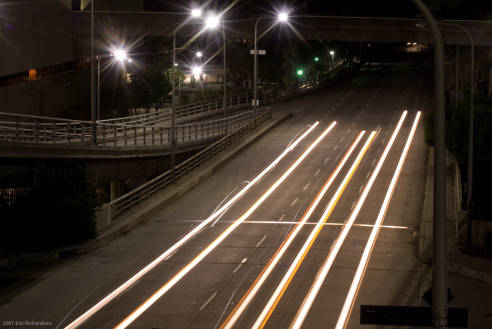
4th street, shown as it transitions from viaduct to cut approaching Hope street in a 2007 photo.

On November 25, 1953, city officials presented detailed plans for the viaduct-cut that would take 4th street over Figueroa and Flower and under Hope and Grand. The plan, which the Times called a "sort of roller-coaster loop over Bunker Hill," replaced a previous agreement to build a tunnel under Bunker Hill.

In 1946, the city and state reached an agreement on how Downtown streets would be reshaped to accommodate new traffic from the planned Harbor Freeway. 3rd, 4th, 5th, 6th, 8th and 9th would be turned into one-way streets. At the time, 4th street dead-ended at Flower street. In order for it to carry traffic as part of a one-way pair with 3rd street, the street would have to be continued across Bunker Hill.

After agreeing to the tunnel, cost estimates made some city officials think twice. In 1949, Councilman Kenneth Hahn protested the $3.6 million project, arguing that the money could be best spent elsewhere in the city.

Plans for the open cut alternative were first released late in 1952, but the plan wasn't approved until November of 1953. The approved design would connect a 687-foot viaduct with a 32-foot deep cut through part of Bunker Hill. The state would pay for the viaduct portion, while the city would bear the cost for the cut and paving.

The new roadway was anticipated to open in January of 1956, but the three-quarter complete project was slowed in the winter of 1955 by a teamsters' strike. The stretch eventually did make it open in May.

For those curious about how steep the slope is on 4th, the stretch from Grand to Olive has an 8% grade, with the steepness rising to 14% between Olive and Hill.


"Mayor Seeks Funds for 4th St. Tunnel :City-State '46 Pact on Harbor Freeway Requires Decision." Los Angeles Times (1886-Current File) [Los Angeles, Calif.] 28 Jul 1949, A1.

"Tunnel Plan Protested by Councilman." Los Angeles Times (1886-Current File) [Los Angeles, Calif.] 2 Aug. 1949,17.

"Great Program to Make 4th St. Major Route Told :Projects Include 800-Foot Open Cut to Eliminate Sharp Grade West of Olive St.." Los Angeles Times (1886-Current File) [Los Angeles, Calif.] 30 Nov. 1952, F1.

"4th St. Cut Project Will Change Face of Bunker Hill Downtown Area. " Los Angeles Times (1886-Current File) [Los Angeles, Calif.] 26 Nov. 1953.

SHARE:

||

Related Topics


Topic:
This Date in Downtown

6 stories


Related Stories:


Conversation

Guest 1

Tornadoes28 on November 25, 2008, at 01:10PM – #1

Boy, what a blunder that plan was. The urban planers back then were really clueless about how a vibrant downtown should look like. Their redevelopment of Bunker Hill ruined that. By having these streets no longer intersect, the sidewalk life was destroyed by a car oriented design.

Look at Grand Ave. from 5th from the library going up the hill. Grand used to have a more gentle slope up the hill and intersected with 4th street. Then these brilliant designers ruined it by raising Grand above 4th. No longer could you have a vibrant intersection of streets but now an almost vertical climb up Grand from the Library. Go take a look a Grand and you can see the street was raised above the building next to it as the windows of the building are now below street level. I'm talking about the building next to the US Bank Tower.


Guest 2

Juanito on November 25, 2008, at 11:40PM – #2

Grand Avenue was not "raised", the top of the hill was cut down further and the Grand Avenue viaduct was constructed between 2nd and 4th, stood alone for many years. Before the grading down, one could walk along Grand from 2nd to 1st and actually walk downhill. Large concrete pylons thrust up in the air right down the center median. I think these were intended to support some sort of future mass transit system.

Civil engineer Steve Mutschenbacher designed the layout and grading.


Guest 1

Tornadoes28 on November 26, 2008, at 10:28AM – #3

Either way, it was a poor urban design.


Guest 3

FreSea on November 26, 2008, at 12:09PM – #4

The Fourth Street cut and Viaduct was a huge urban planning mistake. That hideous viaduct should be removed (like the Central and Embarcadero Freeways in San Francisco) and the western slope could be turned into a lovely stairway/escalator/garden/fountain similar to what was done in front of the Central Library on Fifth.


Guest 4

Scott Mercer on November 26, 2008, at 08:49PM – #5

It makes a nice setting for that very last scene in the movie "Repo Man"...


Guest 5

Tornadoes28 on November 27, 2008, at 12:23PM – #6

And the opening scenes of the first Terminator.


Guest 2

Urban Trojan on November 27, 2008, at 01:16PM – #7

The Fourth Street Freeway, the World Trade Center, the Security Pacific Bank complex (now BOA), the Bonaventure Hotel, the parking garage for ARCO Plaza - all of it conceived by civil engineers and architects without an ounce, no awareness whatsoever of sensible urban design. It is all a nightmare.

And then some bureaucrat at the CRA gets a case of 2001 Space Odyssey on the brain and proposes Pedways and a People Mover.

Send them all to Mars along with Bush! No return ticket.


Guest 6

ubrayj02 on December 03, 2008, at 10:12AM – #8

You guys have got to remember the context of the times. Public places where people gathered to shop and intermingle were considered the terrible breeding grounds for crime and disease (sometimes they were).

The "Anglo" reigned supreme in L.A., and the wrecking crew that followed behind this group's manifest destiny made a killing ripping up everything to service automobiles and real estate speculation.

Cruise through the archival L.A. Times and you'll see the worst, anti-urban, slander coming from both newly minted and long-time residents of L.A. It is too easy to blame just civil engineers and planners of the times.

Engineers and planners were the foot soldiers and propagandists of a several generations of L.A. leaders, and they reflected the opinions of the ruling class in this City.


Add Your Voice


In an effort to prevent spam, blogdowntown commenting requires that Javascript be enabled. Please check your browser settings and try again.


blogdowntown Photo Pool

Photos of Downtown contributed by readers like you.

Downtown Blogs


Downtown Sites


Elsewhere