blogdowntown
Not currently logged in. [Login or Create an Account]

Stay Connected


Photographers' Rights Protest Makes For Good Theatre
By Eric Richardson
Published: Wednesday, January 21, 2009, at 09:29AM
20050109-DSC_3889 Damon D'Amato []

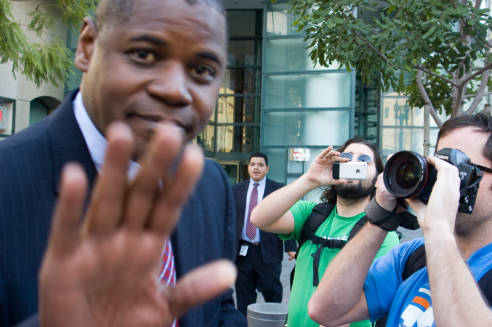
A security guard tries to block a photo at U.S. Bank tower.

The right of a photographer to take photos from public property is a topic that we've discussed several times before. Despite a clear lack of law to back them up, security companies that represent Downtown's office towers are quite insistent in their stance that it is illegal to take pictures of Downtown's landmark structures.

On Sunday, an group of photographers got together to make a stand about their rights to take pictures. The results are sad, but make for some great comedy.

There are several great write-ups of the event, but Bryan Villarin's :

SG2: “Hello. You guys are aware that this is private property, right?” points finger at the building

David: “This is private property?” points finger down to the sidewalk

SG2: “This is private property.” points finger to the building

David: “This is private property?” points finger down to the sidewalk

SG2: “This is private property.” points finger to the building

David: “Doesn’t matter.”

SG2: “Okay. You’re not supposed to take pictures. You’re violating a code. Did he ask you guys if this is a public property?”

Shawn: “No, it doesn’t matter, we’re on public property.”

SG2: “Yes, you are on public property, but you are taking pictures of our building.”

According to the law, the photographers are in the right: taking photos from public property is perfectly legal. There's no distinction about whether the subject material is on property that's public or private.

Be sure to also and .

SHARE:

||

Related Stories:


Conversation

Guest 1

Jeremy R on January 21, 2009, at 07:13PM – #1

I have also run into this problem. To my knowledge there are only two rules when taking pictures

1) Taking photos of a federally protected building in the name of preventing terrorism via the "patriot act" 2) It is a private residence, and you are taking a photo of someone between the cracks of a drawn shade, where there was an "expectation" of privacy.

Office buildings in DTLA do not meet this criterion.

In fact, a security guard was harassing me one day, and luckily enough there was an LAPD car nearby. I told the Police officer to politely inform the security guard of my rights. The cop told me he wouldn't do that, but that I should just keep taking pictures as I please.


Guest 2

Mark on January 21, 2009, at 08:38PM – #2

I occasionally see private property markers embedded in a sidewalk (eg, 7 + Fig). Sometimes such a marker is positioned where I would have thought the property was still public. Are there cases where seemingly-public sidewalk is actually privately owned? I'm relating this to the public beach situation, where "public" means only the sand below mean high tide.


Eric Richardson () on January 21, 2009, at 10:03PM – #3

Mark: That's a great question, and one that got brought up in the discussion on this incident. Typically it would have to do with how much width was initially dedicated for the roadway, but there are certainly cases that are very unclear as just a normal pedestrian.


Guest 3

Benjamin Pezzillo on January 21, 2009, at 11:38PM – #4

There is no section of the Providing Appropriate Tools Required to Intercept and Obstruct Terrorism (PATRIOT) Act prohibiting photography. If you can find one Jeremy R, please correct me:

http://thomas.loc.gov/cgi-bin/query/D?c107:4:./temp/~c107SzC4cT::

Mark's question is on target -- is the section of sidewalk you are standing on public or private? Chances are, unless you are near the curb, it is private property and you are prohibited from photographing UPON it without the express permission of the land owner or designee. If you look at the sidewalk outside the US Bank Tower, there is only a narrow strip of "public" sidewalk, the rest is marked as private property.

Depending on the purpose of the photography, your use of public or private property may require a film permit to comply with the commercial use of property provisions of the Los Angeles Municipal Code.

Furthermore, there are several 'known knowns' to keep in mind before condemning security guards as brainless. One thing we know about terrorists is that they scout their targets in advance -- this has been widely verified through exhaustive investigation into the 9/11 hijackers and subsequent plots both successful and not. Another, is that the US Bank Tower was the target of a terrorist plot. Don't think for a second the security guards at the US Bank Tower are unaware of this. Any security guard working any major building is trained to look for people photographing the building (easily perceived through their eyes as surveillance activity) and instructed to confront them. That is their job. Try giving them a break.

Remember too, in Los Angeles, private property owners get money for renting their property to productions. So expect them to be savvy.

The best advice, as was conveyed when Eric had a confrontation with a security guard some time back he posted about, go talk to the security guard, ask them if you can take a photograph of the property. If they say no, ask them where their property line stops and walk past it before taking any photographs. I suspect that if you photographed the US Bank Tower from across Fifth Street near the Library, the guards would not bother you. But if you are looking to challenge whether or not you can stand on private property and take photographs as you please, expect to lose. Similarly, any security guard attempting to control your behavior off their property will lose if the confrontation escalates.

Keep in mind too, if your photographs are intended for a commercial purpose, you may completely be in the wrong for photographing from public property without a permit. You may also face legal hurdles for photographing trademarked property and using it for commercial purposes without agreement from the proper authority designated to grant such approval (the Hollywood sign and City of Beverly HIlls signs are two shining examples so seemingly public property that are tightly controlled by commercial licensing agreements).

Los Angeles has several attorneys with significant experience in the area of photography law. Most charge in the neighborhood of $300 an hour but it is money well spent if you endeavor to take a photograph you want to generate income from in the future considering the significant risk of legal liability for using a person's or private property's likeness without their consent.


Guest 4

Be Informed Before Criticizing on January 22, 2009, at 10:33AM – #5

One thing to keep in mind if you are persistent and argumentative and in fact are on private property or otherwise acting suspicious, your photo is being taken and sent into the Anti-Terrorism task force. you may or may not get a visit from them questioning as to why you were taking pictures of particular buildings. This is the post 9/11 era we live in.


Guest 5

Dennis Smith on January 22, 2009, at 01:20PM – #6

"This is the post 9/11 era we live in."

"As for our common defense, we reject the false choice between our safety and our ideals." Barack Obama

"He who would give up a little liberty to gain a little security will lose both and deserve neither." Benjamin Franklin


Guest 6

Bob on January 24, 2009, at 11:16AM – #7

Even if the property paid for the sidewalk the supreme court has ruled that in California it's still a public forum for free speech and they must allow right of way activity as long as it resembles a sidewalk and connects to sidewalk around it. No such thing as private sidewalk in ca.

If it were against the law then photographers in CA would be fined, arrested etc for this sort of thing, that never happens for private property tresspass.

Sidewalk is public in nature, you can walk down it taking pictures all day long end of story


Guest 7

Jacob on January 26, 2009, at 09:35AM – #8

I first read about this , and was bothered by the purpose of the group trip: "...to see if they would be blocked from taking pictures anywhere." While gathering with the stated purpose of making "a stand" seems inappropriate when it's just to cause a scene, I can appreciate the effort.

Imagining that this same thing is happening to tourists – who just want to take a picture of an iconic building (or the Bunker Hill Steps) in Downtown LA – is awfully discouraging.


Add Your Voice


In an effort to prevent spam, blogdowntown commenting requires that Javascript be enabled. Please check your browser settings and try again.


blogdowntown Photo Pool

Photos of Downtown contributed by readers like you.

Downtown Blogs


Downtown Sites


Elsewhere