blogdowntown
Not currently logged in. [Login or Create an Account]

Stay Connected


Underground Connector Up for Metro OK

By Eric Richardson
Published: Tuesday, February 02, 2010, at 01:18PM
Regional Connector Render: 2nd Street Looking West Metro

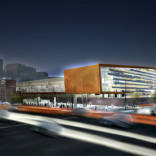
A popular plan to take Metro's proposed Regional Connector light rail link under the intersection of 1st and Alameda will be officially considered by the agency's planning committee this month.

First presented to the Little Tokyo community in November, the underground option must be formally added to the two currently being studied in the project's environmental documents.

The project would link the two pieces of the existing light rail network, bridging the gap between the 7th / Metro terminus used by the Blue and Expo lines with the Gold Line's Little Tokyo / Arts District station.

Two plans currently under consideration both involve at-grade links to the existing Gold Line tracks, an option that the community has been consistently against since the project outreach first started in late 2007.

The new alternative could add up to $200 million onto the project's price tag, which would then total roughly $1 billion.

Project staff will present the new option to the Planning and Programming committee on February 17 18. The Metro board will officially select a "Locally Preferred Alternative" for the project this summer.

Update (Friday): Committee meeting was moved back a day, to February 18.

SHARE:

||

Related Topics


Topic:
Regional Connector

35 stories


Conversation

Guest 1

Russell Brown on February 03, 2010, at 01:44AM – #1

Both Downtown LA Neighborhood Council and Historic Downtown BID have endorsed the all underground option.

This alternative makes the most sense by minimizing the possibility of all on track disruptions since it is ALL grade separated. It also minimizes surface disruptions.

This alternative vastly decreases the mitigation needed at First and Alameda and also offers a 2nd and Broadway station to be connected to the Downtown Streetcar.

Thanks Metro (and Little Tokyo community) for working together on this solution.


User_32

Richard F on February 03, 2010, at 08:52AM – #2

Underground is the ONLY solution to this issue. I'm willing to pay a higher fare if the money will go to building the underground Regional Connector.


Guest 2

Dana Gabbard on February 03, 2010, at 09:20AM – #3

Agency staff will report that this severely undermines the cost effectiveness for this project to compete for federal New Starts funds. All the stakeholder endorsements don't change that simple reality. As a public process this will work its way to that reality and likely the Metro Board will decide expending a fifhy of a billion is not "the ONLY solution".

Mr. Brown, to speak of minimizing surface disruptions shows no insight of what constructing this would entail. Much less its ongoing impact--like the twin portals.

Anyway, that is how I see it as a longtime Metro observer and daily train user.


Guest 2

Dana gabbard on February 03, 2010, at 09:22AM – #4

Dang, I meant daily transit user (although I ride rail from time to time, I mostly get around on the bus).


Guest 3

Russell Brown on February 03, 2010, at 01:56PM – #5

Metro has stated when the system is fully operational, that trains will be passing either way every 75 seconds. In public meetings of connecting the Harbor subdivision to downtown and Unin Station, they have already stated this (as yet unbuilt station) is already overcapacity to link the airport and south bay through this linkage.

Add in the impact of high speed rail overhead through the adjacent neighborhood. That train will add the capacity of a small airport to Union Station.

These cumulative impacts and the density that follows tells you why Little Tokyo and the residents do not want an above ground portal. Add to that the surface traffic at Alameda and Temple and Alameda and 2nd and you can see why the surface option did not work for the community.

You are correct that the station build out will be a large impact, but that lasts 2-3 years as opposed to forever with a surface route.

A single car crash on the tracks, a wayward pedestrian, an abandoned knapsack that is perceived as a bomb left at the station would shut down the entire system from Pasadena to long Beach or Whittier to Santa Monica.

You are correct that the cost numbers must also be there but the mitigation costs of a trench for Alameda, a overhead maze above the tracks, the complete separation on the Nikei Plaza and the Arts District from the rest of Little Tokyo leave few options.

Little Tokyo was ready to kill the ENTIRE PROJECT because of the impacts.

A big part of the new cost is an added station at Broadway and 2nd. That will link to the streetcar and Redline station nearby. 2nd and Broadway is a prime location for a dense TOD (with partner participation that can offset some of the costs). That station will also increase ridership from Historic Downtown, provide an entry for Grand Avenue project eastside and will be the main portal for entry for all events at City Hall and the Grand Avenue Park.


Guest 3

Russ Brown on February 03, 2010, at 02:29PM – #6

Attached is a link to an interesting article on the changing of emphasis on scoring for projects for federal funding.

Not just time saved, but also sustainability, liveability, development potential and local match is now factored in to the equation. Measure R (1/2 cent sales tax- up to $40 billion) and Prop 1C $10 billion high speed rail bonds have radically changed the transit future of LA County and eventually the state.18 months ago, this was all dreaming so A LOT has changed.

http://www.thetransportpolitic.com/2010/02/03/for-2011-fta-shifts-focus-away-from-project-cost-effectiveness-index-and-towards-local-financing-commitment/


Guest 3

Russ Brown on February 03, 2010, at 02:33PM – #7

My error. High speed rail measure was Prop 1A not 1C.


Guest 4

Pauly on February 03, 2010, at 03:00PM – #8

I spoke to the MTA project manager and asked her directly about the potential change in "cost-effectiveness" of the new option. She said that it was not "blown out of the water" as Dana Gabbard has indicated in her observations and I think that is a reason why it is on the table for consideration. I would agree that cost-effectiveness is affected a little because of the added cost in keeping it all underground. IMO the benefits far outweigh the negatives as Russ outlines very well.

I don't have a problem with raising a concern about cost-effectiveness, but stating this extra $200 million as "severely" undermining without any substantive evidence or factual data is not fair.


Guest 5

Roger Christensen on February 03, 2010, at 03:38PM – #9

The Connector has always appeared as #1 in cost effectiveness in Metro project lists and with the new Fed guidelines there is certainly no issue here. I am particularly fond of the 2nd/broadway station that will make an easy connection to the future Broadway streetcar line.
The Bunker Hill station also exciting. Isn't this the site that Eli Broad is eyeing for his future art museum?


Eric Richardson () on February 03, 2010, at 04:09PM – #10

Roger: The Bunker Hill station would be on the west side of Hope (in the grassy area that's there now), which the Grand Avenue site that could house the Broad museum is on the east (currently parking lot). It could be very interesting to see how the museum building would help flow pedestrians up to Grand Avenue from the station.


Guest 2

Dana Gabbard on February 03, 2010, at 07:21PM – #11

We'll soon know whether my concerns are justified, as I am sure Raffi Hamparian of Metro Govt' Relations will let the Board know what impact the tunnel option would have on our New Starts prospects if it is added to the options studied. Metro's staff are champions at wringing precious capital dollars out of D.C. so I am eager to hear their thoughts on the topic.


Guest 6

Russ Brown on February 04, 2010, at 10:07AM – #12

Spoke with Metro planners and the all underground option actually has 2 choices at the Office Depot site. Both will work within the economics of the project. The options are a traditional underground station and a stacked station like Wilshire and Vermont.

Of course undergrounding an additional station and building a 4th station at 2nd & Broadway is more expensive. But those choices also give you a much better system and allow the option for increased density above the stations.

However, it is also expensive to dig out Alameda and build an Origami Maze with barricades between all the rail lines and the community.

Little Tokyo is one of the best pedestrian neighborhoods in the city. It is worth protecting. The support of the community is critical for a project to move forward. (Want to talk about 710 freeway extension?)

If the only consideration was direct track and station costs, with no mitigation and no concern for the context of the neighborhood, the entire system would be above ground. That system would also be a rail freeway outside the front door of many businesses.

Everyone knows that if the Gold Line eastside extension and the Regional Connector had been built as one project, the present configuration of the First and Alameda station would not exist.

The Nikkei Plaza project will be significantly better by having open access on Alameda and First with easy pedestrian passage and landscaping as opposed to the barriers of rail tracks and safety barricades.

This missing link will be the backbone of the entire rail system county wide. Eventually a rail corridor from Washington and Alameda to Union Station will be required to provide more capacity as the full length of the Expo line to 3rd Street Promenade/ SM Pier, Crenshaw line and Harbor subdivision line come on board. Add in the Gold Line Foothill Extension to Ontario Airport and an extension of the recently opened East LA Gold Line much further east and we will have a pretty extensive light and heavy rail network. (Just 30 years later than we should have).


Guest 7

Roger Christensen on February 08, 2010, at 11:06AM – #13

I hesitate to raise this issue because discussion of this gets trivial. But what color the lines are will be determined by how the Connector is used.

If service is divided by 2 essential lines, north/south Long Beach to Pasadena could be Blue and east/west Atlantic to Pacific Ocean could be Gold. Simple but changes colors of existing service.

If the current Gold route was preserved and service destinations split: Aqua could be Santa Monica to East LA making the current East side service both Gold and Aqua until it potentially splits after Atlantic. Similar options exist for directions from Pasadena using Blue and Gold.

All of this awaits the key decision as to how Connector service will be utilized.


Guest 8

Joel C on February 08, 2010, at 04:26PM – #14

The Regional Connector will make it possible to have multiple lines on each track segment. Theoretically, there are six potential lines:

(1) Blue Line from Long Beach to Pasadena,

(2) Gold Line from East L.A. to Pasadena,

(3) Expo Line (Aqua) from Santa Monica to Pasadena,

(4) Tan Line from Santa Monica to East L.A.,

(5) Shore Line (Copper) from Santa Monica to Long Beach, and

(6) Atlantic Line (Yellow) from Long Beach to East L.A.

Of course, these are just suggestions, since the names could be done in any of several different ways.


Add Your Voice


In an effort to prevent spam, blogdowntown commenting requires that Javascript be enabled. Please check your browser settings and try again.


blogdowntown Photo Pool

Photos of Downtown contributed by readers like you.

Downtown Blogs


Downtown Sites


Elsewhere